USS Stargazer NCC-2893
Constellation-class deep-space explorer, registry NCC-2893: the overworked, underpowered ship a young lieutenant named Jean-Luc Picard took command of in a crisis in 2333 and kept for twenty-two years—until the Battle of Maxia took it from him, and a Ferengi grudge brought it back.
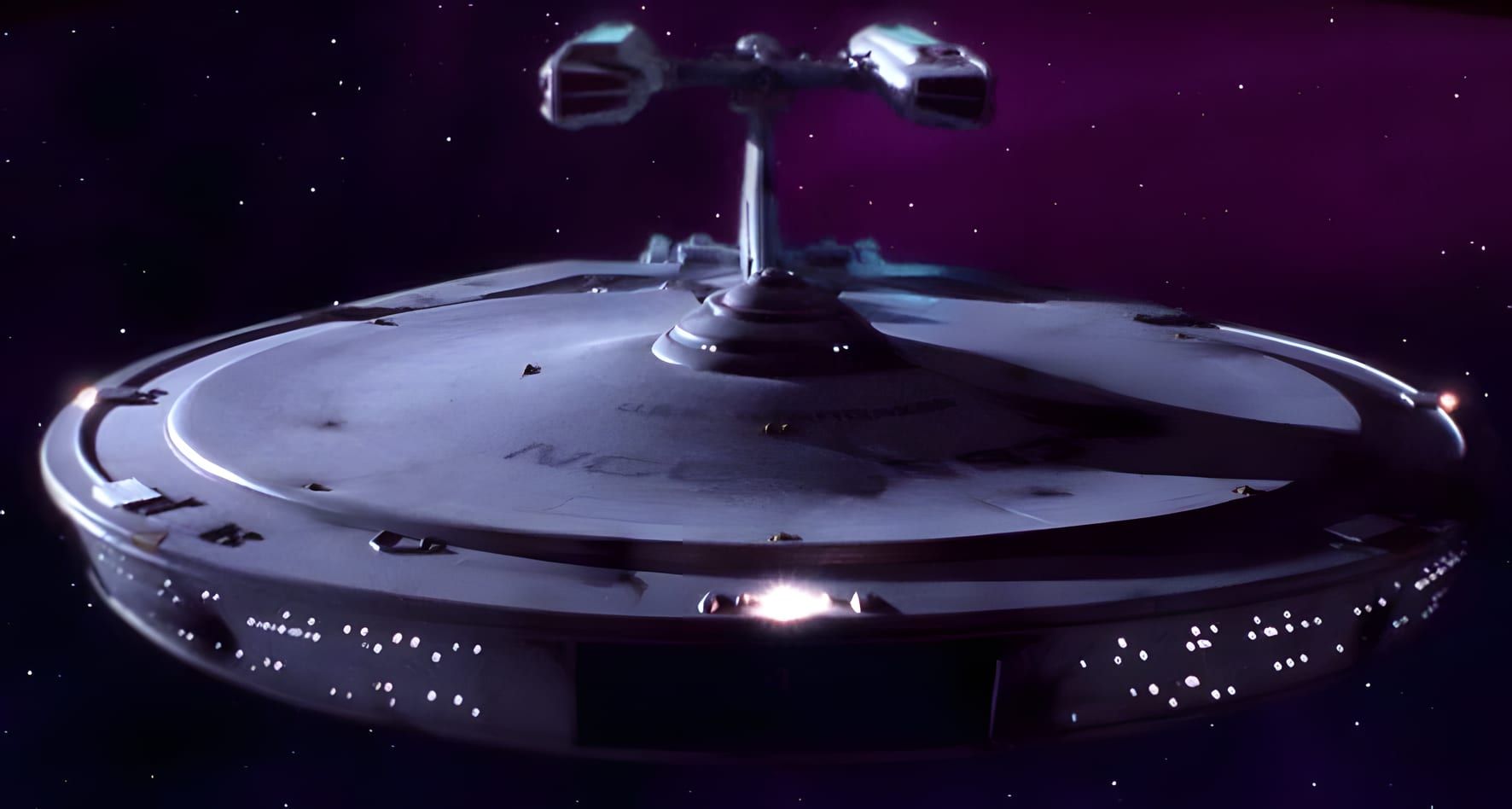
Service dossier
- Registry / identity
- NCC-2893 (some early archive material records the registry as NCC-7100)
- Class / type
- Constellation-class Federation starship; deep-space explorer / cruiser configuration
- Picard's role
- Bridge officer, then commanding officer for twenty-two years (2333–2355)
- Recorded period
- Entered service in 2326; lost at Maxia Zeta in 2355; returned to Federation control in 2364; museum ship by 2401
Why this ship matters
The USS Stargazer, registry NCC-2893, was the second Starfleet vessel to bear the name. It entered service in 2326 as a Constellation-class deep-space explorer, and Picard later remembered it, with the affection reserved for first commands, as an “overworked, underpowered vessel, always on the verge of flying apart at the seams.”
In 2333, Picard was a junior bridge officer aboard when the ship's captain was mortally wounded in a crisis. He took command of the bridge, brought the ship through, and was given the captaincy outright—a promotion he would hold for the next twenty-two years, the longest single command of his career and the crucible in which the rest of it was formed.
The Stargazer's record is also the record of the officers it trained: first officer Gilaad Ben Zoma, weapons officer Vigo, second officer Jack R. Crusher—Beverly Crusher's husband, killed on an away mission in 2353—and physician Moritz Benayoun, who was still Picard's personal doctor nearly half a century later.
In 2355, an unidentified vessel ambushed the Stargazer in the Maxia Zeta system. Picard destroyed the attacker with an improvised warp-driven feint later codified as the Picard Maneuver—and then had to abandon his burning ship anyway. The survivors drifted in shuttlecraft for weeks before rescue.
Because losing a starship triggers a mandatory court martial, Picard was prosecuted for the loss of the Stargazer by Phillipa Louvois and absolved of all charges. The identity of the attacker remained unknown to Starfleet for nine years.
In 2364, the Ferengi DaiMon Bok—whose son had commanded the vessel destroyed at Maxia—returned the salvaged Stargazer to the Federation as the opening move of an elaborate revenge scheme involving falsified logs and an illegal thought maker. The scheme failed; the ship came home; the Stargazer eventually became one of the honoured exhibits of the Fleet Museum.
NCC-2893: Registry, Class, and the Constellation Design
The literal registry NCC-2893 belongs to the second of several Federation starships to carry the Stargazer name, and by a wide margin the most consequential. The hull was a Constellation-class explorer, a design built for a specific problem: deep-space assignments measured in years, far from starbase support, where endurance mattered more than speed and redundancy mattered more than comfort. The class's signature is its four warp nacelles, paired in upper and lower banks—not for raw velocity, but so that a ship operating beyond the reach of any drydock could lose an engine and keep flying.
By the time Picard served aboard, the design was already middle-aged, and the Stargazer wore its mileage openly. Picard's own description—overworked, underpowered, always on the verge of flying apart at the seams—is the one that survives in the record, and it was not false modesty. Constellation-class ships of the Stargazer's generation ran long duty cycles between overhauls; the ship returned to Earth for a full refit only rarely during Picard's tenure, and its crews became correspondingly self-sufficient.
One archival oddity deserves a note. Some early records and display materials associate the Stargazer with the registry NCC-7100 and with Constitution-class specifications—an artifact of the similar class names and of inconsistent record-keeping in the older archives. Later technical records settled the matter: the ship was Constellation-class, registry NCC-2893, and it is under that registry that the hull is preserved today.
2333: A Lieutenant Takes the Bridge
The defining fact of the Stargazer's history is how Picard came to command it. In 2333 he was a junior bridge officer—a lieutenant, not a contender for the centre seat—when the ship was crippled in an engagement and its captain mortally wounded. Surviving accounts differ on the particulars of the action; service records name Daithan Ruhalter as the captain who fell, and place an earlier commander, Anton Manning, aboard in the late 2320s. What every account agrees on is the sequence that followed: with the senior officers dead or incapacitated, Picard took command of the bridge, stabilised the crisis, and brought the ship home.
Starfleet Command's response was unusual. Rather than installing a more senior captain over the lieutenant who had saved the ship, it confirmed him in the chair. Picard was given permanent command of the Stargazer—a battlefield promotion ratified into a career—and held it for twenty-two years, from 2333 to 2355. No other posting in his service record comes close to that duration; his celebrated command of the Enterprise-D lasted eight years.
The length of the command shaped the man. Two decades on a deep-space explorer, most of it far from Federation space, taught Picard the habits his later crews would recognise instantly: the reserve of a captain who had been the final authority for too long to be casual about it, the archaeologist's patience, and a settled belief that an old, imperfect ship crewed by people who trust each other beats a new one that hasn't been tested.
Two Decades in Deep Space
Most of the Stargazer's twenty-two years under Picard were spent doing the unglamorous work the Constellation class was built for: long-duration exploration far beyond the starbase network, where a ship might go years between resupply and a captain's decisions could not be referred upward. The surviving mission record is necessarily incomplete—much of the tour predates the modern archive, and at least one assignment, the mission to the fireforest of Calyx, remains partially classified—but the entries that survive sketch the shape of the command.
In 2339 the ship came under fire from an automated planetary defence system that had outlived its builders by eleven million years; Picard threaded the Stargazer through a gap in the weapons' coverage so his science officer could shut the network down. In 2341 the ship was thrown ten days forward in time by a microscopic quantum singularity, and was recovered only when the crew worked out how to resynchronise the warp nacelles with the rest of the hull—an incident that sent the ship back to Earth for one of its rare full overhauls. In 2345 it made brief, courteous, and final contact with aquatic beings living in the mantle of an ice giant, who asked to be left alone and were. In 2348 it turned an attempted ambush by Acamarian Gatherers into a peaceful resolution—and a round of radiation treatment for the would-be ambushers, administered by the Stargazer's own surgeon.
The tour had darker entries. During the long hostilities with the Cardassian Union, the Stargazer was sent into sector 21503 to extend a truce offering, and Picard lowered his shields as a gesture of good faith. The Cardassians answered by opening fire, crippling most of the ship's weapons and its impulse engines before the Stargazer clawed its way clear. Picard carried the lesson—about trust extended and trust betrayed—into every Cardassian negotiation he conducted afterward. And in 2353 came the worst day of the command: Jack R. Crusher, Picard's friend and one of his finest officers, killed on an away mission. Picard brought the body home to Beverly Crusher himself, because he owed Jack nothing less.
The ship's last routine port of call in the record is Chalna in 2354, a negotiation over the withdrawal of a Federation colony. Within a year, the Stargazer would be a burning hulk in the Maxia Zeta system, and the long tour would be over.
Notable Crew of the Stargazer
Twenty-two years under one captain made the Stargazer's wardroom unusually stable, and unusually well documented. The roster below records the officers whose service aboard NCC-2893 left a mark on the wider Starfleet record; ranks shown are those most consistently attested, and several of these officers held more than one posting across the long command.
Two names carry weight beyond the ship. Jack R. Crusher, Picard's close friend and one of his most trusted officers, was killed on an away mission in 2353; Picard personally returned his body to his widow, Beverly Crusher, a duty that shadowed both their lives for decades afterward. And Dr. Moritz Benayoun outlasted the ship itself in Picard's life: half a century after Maxia, it was still Benayoun whom the retired admiral trusted with his medical certifications—and with the harder conversations.
| Officer | Posting | Noted in the record for |
|---|---|---|
| Jean-Luc Picard | Bridge officer; commanding officer from 2333 | Battlefield promotion to the captaincy; the Picard Maneuver at Maxia |
| Gilaad Ben Zoma | First officer | Picard's long-serving executive officer across most of the command |
| Jack R. Crusher | Second officer; senior bridge officer | Killed on an away mission in 2353; husband of Beverly Crusher |
| Vigo | Weapons officer | The gunner Picard cited for years afterward as the model of the posting |
| Carter Greyhorse | Chief medical officer | Ship's surgeon through much of the deep-space tour |
| Moritz Benayoun | Medical officer | Remained Picard's personal physician into the 2390s |
| Idun & Gerda Asmund | Helm and navigation | Twin sisters, raised by Klingons, who flew the ship for years |
| Phigus Simenon | Chief engineer | Kept an “overworked, underpowered” ship flying for two decades |
| Elizabeth Wu | Second officer (earlier tour) | Senior watch officer in the command's first years |
The Battle of Maxia, 2355
In 2355 the Stargazer was operating in the Maxia Zeta star system when an unidentified vessel rose from cover and attacked without hail, warning, or any response to the Stargazer's attempts at communication. The first pass tore into the ship; the attacker was faster, fresher, and apparently intent on a kill. The Stargazer—old, slow, and badly hurt—could neither outrun the hostile ship nor survive a stand-up exchange.
What Picard did next entered the tactical textbooks. He ordered his helm to fix a precise bearing on the attacker, jumped the Stargazer to high warp directly along that bearing for a handful of seconds, and dropped out of warp at point-blank range. Because the ship had briefly outrun its own light, the attacker's sensors showed two Stargazers at once—and its gunners fired on the image, the place where the ship had been. The real Stargazer emptied its phasers and six photon torpedoes into the hostile vessel at close range. The attacker was destroyed with all hands. The improvisation was later codified, named, and taught as the Picard Maneuver—to its author's lasting, visible discomfort.
Winning the exchange did not save the ship. The Stargazer was on fire and losing power, and Picard gave the order he would describe ever afterward in the flat tone reserved for the worst entries in a log: abandon ship. The survivors took to shuttlecraft and drifted for weeks before rescue. The hulk was left behind in the Maxia Zeta system, in a decaying orbit, presumed lost.
The aftermath followed Starfleet procedure. The loss of a starship triggers a mandatory court martial of its commanding officer, and Picard was duly prosecuted—by Phillipa Louvois, a JAG officer whose path would cross his again decades later—and absolved of all charges; the maneuver itself entered the citation record alongside his Grankite Order of Tactics. One question the inquiry could not answer: who had attacked the Stargazer, and why. The hostile ship had refused all communication and left no survivors. Starfleet Intelligence's working suspicion at the time pointed at the Cardassians. It was wrong, and the truth stayed buried for nine years.
The Ferengi Connection and the 2364 Return
The attacker at Maxia had been a Ferengi vessel, and the battle that made Picard's reputation had destroyed the first command of a young DaiMon—the son of a senior Ferengi officer named Bok. Shortly after the battle, a ship under Bok's command entered the Maxia Zeta system searching for the missing vessel and found, instead, the abandoned Stargazer in its decaying orbit. Against the instincts of his own crew, Bok claimed the wreck as a personal prize and spent years restoring it with scavenged parts and components bought from corrupt dealers—not for profit, which would at least have been orthodox, but for revenge.
In 2364, Bok requested a meeting with the USS Enterprise-D—Picard's new command—and, in a gesture without precedent in Ferengi-Federation relations, formally returned the Stargazer at no charge. It was the moment Starfleet finally learned who had attacked the ship nine years earlier. It was also a trap. Bok had falsified entries in the Stargazer's recovered logs to suggest Picard had fired first at Maxia, and had hidden an illegal thought maker—a banned Ferengi mind-control device—in Picard's old quarters aboard the ship.
The device worked on the captain across the distance between the two ships, dragging him back into the battle until he could no longer tell memory from the present. Drawn aboard the Stargazer and convinced he was once again at Maxia, Picard began the opening moves of his own maneuver—against the Enterprise. The attack failed for a reason that belongs in the same textbook as the maneuver itself: Data computed the first effective counter to the Picard Maneuver, anticipating the ship's true position and anchoring the Stargazer with a tractor beam the moment it dropped out of warp. The device was destroyed, Picard came back to himself, and Bok was relieved and arrested by his own first officer, for the most Ferengi of reasons: the entire scheme had been conducted at a loss.
A Starfleet tug subsequently took the Stargazer under tow to Xendi Starbase 9. Picard's closing words on the affair—let the dead rest, and the past remain the past—are among the most quoted lines in his service record. After three decades, two battles, and one act of weaponised salvage, NCC-2893 was home.
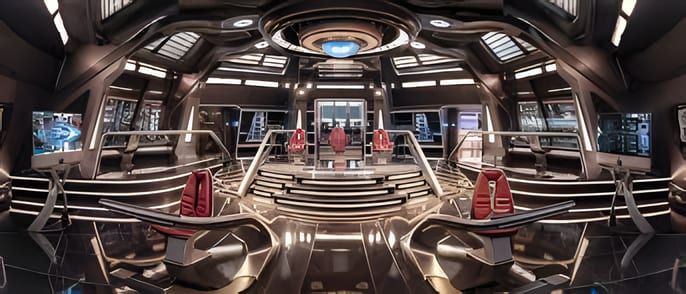
USS Stargazer Bridge Layout
The Stargazer bridge was a Constellation-class command deck from the 2320s: compact by later Galaxy-class standards, built for a smaller crew operating far from support for years at a time. Picard held the centre seat here for twenty-two years—the longest single command of his career—and the layout is preserved in Fleet Museum records alongside the restored NCC-2893 hull.
Constellation-class: Specifications
The Constellation class was conceived as a deep-space cruiser and exploratory vessel: a ship that could be sent far beyond the starbase network for years at a time and be expected to come back. The figures below are the Daystrom Institute's published reference values for the class as configured during the Stargazer's service life, consistent with the preserved hull at the Fleet Museum; individual ships of the class varied in fit and refit across their long careers.
| Parameter | Value |
|---|---|
| Class | Constellation |
| Type | Deep-space explorer / cruiser |
| Registry | NCC-2893 (NCC-7100 in some early archive material) |
| Entered service | 2326 |
| Length | ~310 m |
| Decks | ~15 |
| Crew complement | ~535 |
| Propulsion | Four warp nacelles in paired upper and lower banks; redundancy fit for extended deep-space operation |
| Performance | Modest by later standards; the class traded speed for endurance and was considered underpowered by the 2350s |
| Armament | Phaser banks; photon torpedo launchers (six torpedoes fired in the single salvo that ended the Battle of Maxia) |
| Embarked craft | Shuttlecraft complement sufficient to evacuate the surviving crew in 2355 |
| Defining action | The Picard Maneuver at Maxia Zeta, 2355 |
| Disposition | Lost 2355; salvaged and restored by DaiMon Bok; returned 2364; preserved at the Fleet Museum |
Legacy: The Museum Ship and the NCC-82893
After the tow to Xendi Starbase 9, the Stargazer never returned to active service, but it was never scrapped either. The hull eventually entered the collection of the Starfleet Fleet Museum at Athan Prime, and by 2402 the restored NCC-2893 stood on display in a place of honour—near the rebuilt Enterprise-D, whose recovery had bookended the other end of Picard's career. Starfleet Academy had by then formally honoured the ship for its part in two historic engagements.
The name outlived the hull. In 2401 a new USS Stargazer, NCC-82893—a Sagan-class vessel under Captain Cristóbal Rios, its registry a deliberate echo of the original's—carried the name back into front-line service, and it was aboard that ship that the retired Admiral Picard's final sequence of crises began. The registry archive treats the two ships as a single lineage; this archive keeps separate pages, because the stories deserve the room.
Picard himself never quite let the ship go. He kept a model of the Stargazer close at hand throughout his later commands and into his retirement archive. He once told Montgomery Scott—a man with his own opinions about beloved old ships—that he sometimes wished he could command the Stargazer again. And when Agnes Jurati assumed the Picard Maneuver had been born on an Enterprise, he corrected her with the precision of a man defending a friend's memory: it was the Stargazer. It was always the Stargazer.