USS Enterprise-E
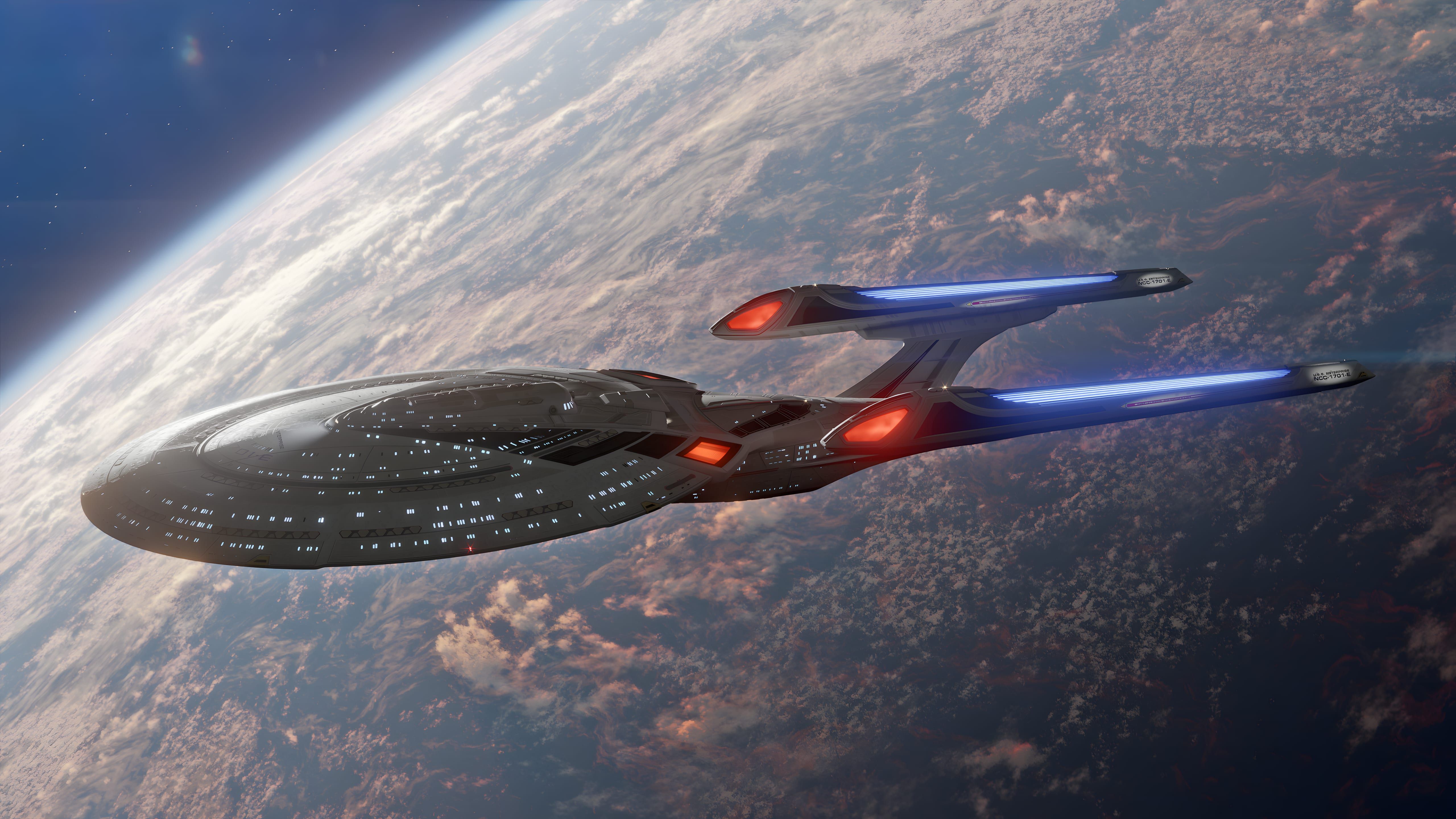
The Sovereign-class successor that carried Picard from the Borg's time war to the Son'a crisis, Shinzon, and the uncertain end of his starship command.
Service dossier
- Registry / identity
- NCC-1701-E
- Class / type
- Sovereign-class Federation starship
- Picard's role
- Commanding officer until his 2381 promotion to admiral
- Recorded period
- Launched on stardate 49827.5; Picard commanded from the 2370s to 2381; out of service by the 2380s
Why this ship matters
The USS Enterprise-E was the sixth Federation starship to carry the name Enterprise. It launched from San Francisco Fleet Yards as the pinnacle of Sovereign-class design, with Jean-Luc Picard in command and most of the Enterprise-D senior staff reassigned aboard.
Compared with the Enterprise-D, this ship's recorded service was more crisis-driven: the Battle of Sector 001, the Borg incursion into 2063, the Ba'ku relocation conspiracy, and Shinzon's attack in the Bassen Rift.
Picard left the ship in 2381 when he was promoted to admiral to lead the Romulan rescue effort. By the mid-2380s the Enterprise-E was out of service, with later comments implying an unresolved incident tied, at least jokingly, to Worf.
The Fate of the Enterprise-E
Was the Enterprise-E destroyed? The ship's final fate is officially unrecorded. What the record establishes is this: the Enterprise-E was no longer in Starfleet service by 2401, the circumstances of its loss have never been disclosed, and when the subject comes up among those who served aboard, Worf maintains—firmly, and without elaboration—that it “was not my fault.” In 2401, when the old command crew needed a ship from the Fleet Museum for the Frontier Day crisis, Geordi La Forge ruled out the Enterprise-E so flatly that nobody bothered to ask why. That exchange, and Worf's standing denial, are the closest things to an official answer that exist.
What the record does establish is a boundary around the mystery. The Enterprise-E survived every documented crisis of its service—the Battle of Sector 001, the Borg boarding action of 2373, the isolytic ambush in the Briar Patch, the ramming of the Scimitar in the Bassen Rift—and was repaired and refit after each. Declassified logs keep it active into the early 2380s, then thin out: a posting at Kriilar Prime, Captain Worf's tenure in the centre seat, and an indication that the ship was out of service by 2386 following a classified mission.
Everything beyond that line is speculation, and should be read as such. The pairing of Worf's command with the ship's disappearance from the rolls invites the obvious theories—a final mission gone wrong, a loss judged unsuitable for publication, an incident folded into the sealed records of a difficult decade. None is confirmed. What can be said with confidence is narrower and stranger: of the six Enterprises to that point, the E is the only one whose ending Starfleet simply declined to write down. The Enterprise-D was lost saving a world and recovered for a museum; the E's last entry is a joke, a denial, and a sealed file.
Construction and Crew
The Sovereign-class Enterprise-E launched on stardate 49827.5 from San Francisco Fleet Yards. Starfleet assigned Jean-Luc Picard to command once more, and much of the former Enterprise-D crew transferred with him.
The returning senior staff included William Riker, Data, Geordi La Forge, Beverly Crusher, and Deanna Troi. Worf was the major exception, having transferred to Deep Space 9, though he would return to the ship for several later crises.
One construction-history account suggests the hull had already been under construction under another name when the Enterprise-D was destroyed, then was rechristened in honor of the lost flagship.
The Borg and 2063
After nearly a year in space, the Enterprise-E was ordered to patrol the Romulan Neutral Zone during the second Borg incursion. Officially, Starfleet cited concern over Romulan opportunism; in practice, Starfleet was wary of putting Picard near the Borg again.
Picard disobeyed orders and took the ship to Earth, where his residual link to the Collective let him identify a vulnerable point on the Borg cube. The fleet concentrated fire there, destroying the cube and winning the Battle of Sector 001.
Before the cube was destroyed, it launched a sphere through a temporal vortex to 2063, intending to stop Zefram Cochrane's Phoenix flight and prevent first contact with the Vulcans. Protected by the temporal wake, the Enterprise followed the Borg into the past and destroyed the sphere.
The trip damaged the ship's sensors and shields, and Borg drones transported aboard before their vessel exploded. They began assimilating the Enterprise from main engineering and sickbay on Deck 16, converting corridors, building regeneration alcoves, and pushing through crew defense lines.
Picard led a team to stop a Borg interplexing beacon on the deflector dish, then reluctantly ordered evacuation and auto-destruct when the Borg reached too far into the ship. Data ultimately deceived the Borg Queen, ruptured a plasma coolant tank, and helped Picard retake the vessel.
The crew protected Cochrane's launch and first contact with the Vulcans. Using Luna's gravitational field to remain hidden, the Enterprise recreated the Borg temporal vortex and returned to 2373 for repair and removal of Borg components.
The Briar Patch
During the Dominion War, the Enterprise-E was kept in a diplomatic role while the Federation Diplomatic Corps worked toward ending the conflict. In 2375, a diplomatic mission involving the Evora and a planned dispute resolution in the Goren system led the crew toward the Briar Patch.
There, Picard uncovered a conspiracy by the Son'a and Starfleet Admiral Dougherty to remove the Ba'ku from their homeworld and harvest metaphasic radiation from the planet's rings. Picard judged the relocation a grave Prime Directive violation and resigned his commission to defend the Ba'ku.
Riker took the Enterprise through the Briar Patch to alert the Federation Council. The region disrupted communications and warp drive, and Son'a battle cruisers intercepted the ship with isolytic weapons.
The Enterprise was badly damaged and had to eject its warp core to seal a dangerous subspace tear. Riker then used metreon gas native to the Briar Patch as a trap, destroying one Son'a vessel and damaging another in a tactic La Forge jokingly suggested might become known as the Riker Maneuver.
The ship returned to the Ba'ku planet, helped Picard stop the Son'a collector, rescued him before the collector exploded, and then left the Briar Patch for Earth.
Refit and the Scimitar
Between 2375 and 2379, the Enterprise-E underwent a major refit. It gained additional aft-facing and forward-facing torpedo tubes, updated bridge consoles and handrails, new nacelle pylons, and extra phaser arrays.
In 2379, the ship returned to Earth for Riker and Troi's wedding before departing for Betazed. En route, it detected unusual positronic signals from the Kolarin system and recovered B-4, a prototype Soong-type android.
The discovery led into Shinzon's trap. The new Romulan praetor claimed to want peace, but his real goal was to capture Picard, obtain Starfleet tactical data, and use the warbird Scimitar to destroy all life on Earth.
In the Bassen Rift, the Enterprise fought the Scimitar and suffered severe damage, including a major breach on the bridge and the loss of the viewscreen and controls. With the warp core disabled, Picard ordered Troi to ram the Enterprise into the Scimitar.
The collision disabled Shinzon's ship but left the Enterprise crippled. Data transported aboard the Scimitar and sacrificed himself to destroy the thalaron weapon, saving Picard, the Enterprise, and Earth.
After the battle, the Enterprise returned to Earth for extensive repairs in spacedock. Unverified post-battle personnel notes name Commander Martin Madden as Riker's replacement and place the ship on course for the Denab system after refit.
The 2380s and Uncertain Fate
In 2381, Picard was promoted to admiral and left the Enterprise to lead the construction and deployment of a massive transport fleet for the evacuation of Romulus before its sun went supernova.
The ship remained active into the early 2380s. In 2382, it was part of a response to a universe-threatening quantum fissure and later helped tow Starbase 80 to the permanently open rift. In 2384, it appeared in fleet records and was among the ships involved in the Protostar crisis.
Later 2380s records are murkier. Declassified Picard-era logs place the ship at Kriilar Prime, connect that decade to Captain Worf leaving the vessel, and indicate that the Enterprise-E was out of service by 2386 after a classified mission.
In 2401, when the old crew needed a ship from the Fleet Museum, Geordi La Forge said they obviously could not use the Enterprise-E. Worf quickly insisted that whatever happened was not his fault, leaving the exact fate of the ship deliberately unresolved.
The line continued with the Odyssey-class USS Enterprise-F, launched in 2386 and active into the late 24th century.
USS Enterprise-E Bridge Layout
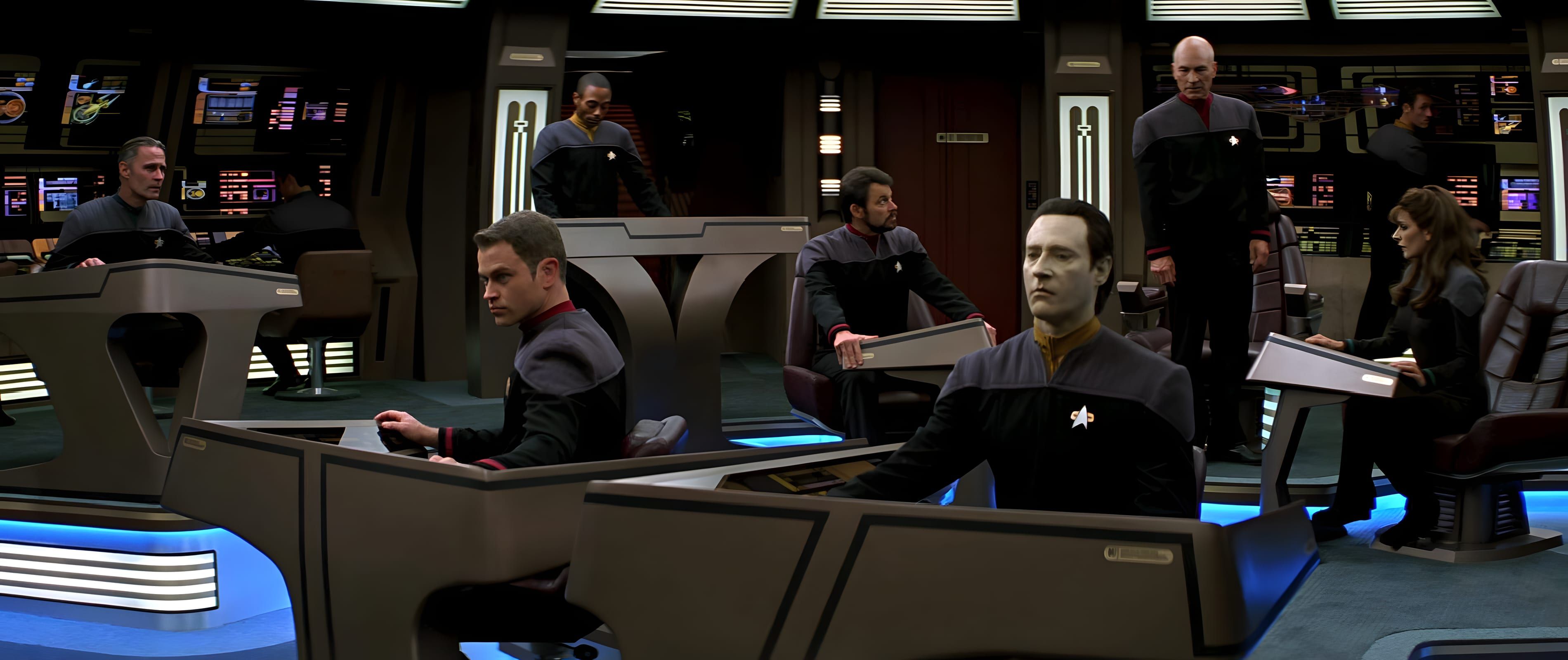
The Enterprise-E's bridge was a Sovereign-class command deck: smaller and darker than the Enterprise-D's family-room expanse, and unambiguously built for a fighting ship. The captain's chair sat at the centre with matching seats for the first officer and counselor to either side—the one carry-over from the D's three-chair arrangement—while conn and ops sat forward, paired ahead of the command chairs and facing the main viewscreen. Tactical occupied a freestanding console behind the command area rather than the D's long wooden rail, with engineering, science, and mission stations arranged along the aft bulkhead sweep.
The room changed with the ship's combat record. The refit completed by 2379 added handrails through the command well, replaced console surfaces, and installed a manual steering column—a fold-away flight stick at the conn that let a pilot fly the starship by hand when automation failed. The bridge also paid for its position atop Deck 1: during the Bassen Rift engagement, the Scimitar's fire breached the bridge directly, tearing away the viewscreen and a section of the forward hull while emergency forcefields held the atmosphere and the crew fought on at open stations. It was from this bridge that Picard ordered the Enterprise rammed into the Scimitar—and at the conn's manual column that the collision course was flown.
For all its tactical fittings, the bridge kept the line's traditions: the ready room aft, the observation lounge with its models of earlier Enterprises, and the dedication plaque by the turbolift. It served as Picard's command deck from the ship's launch to his 2381 promotion to admiral—longer than he held the bridge of the D.
Sovereign-class: Specifications
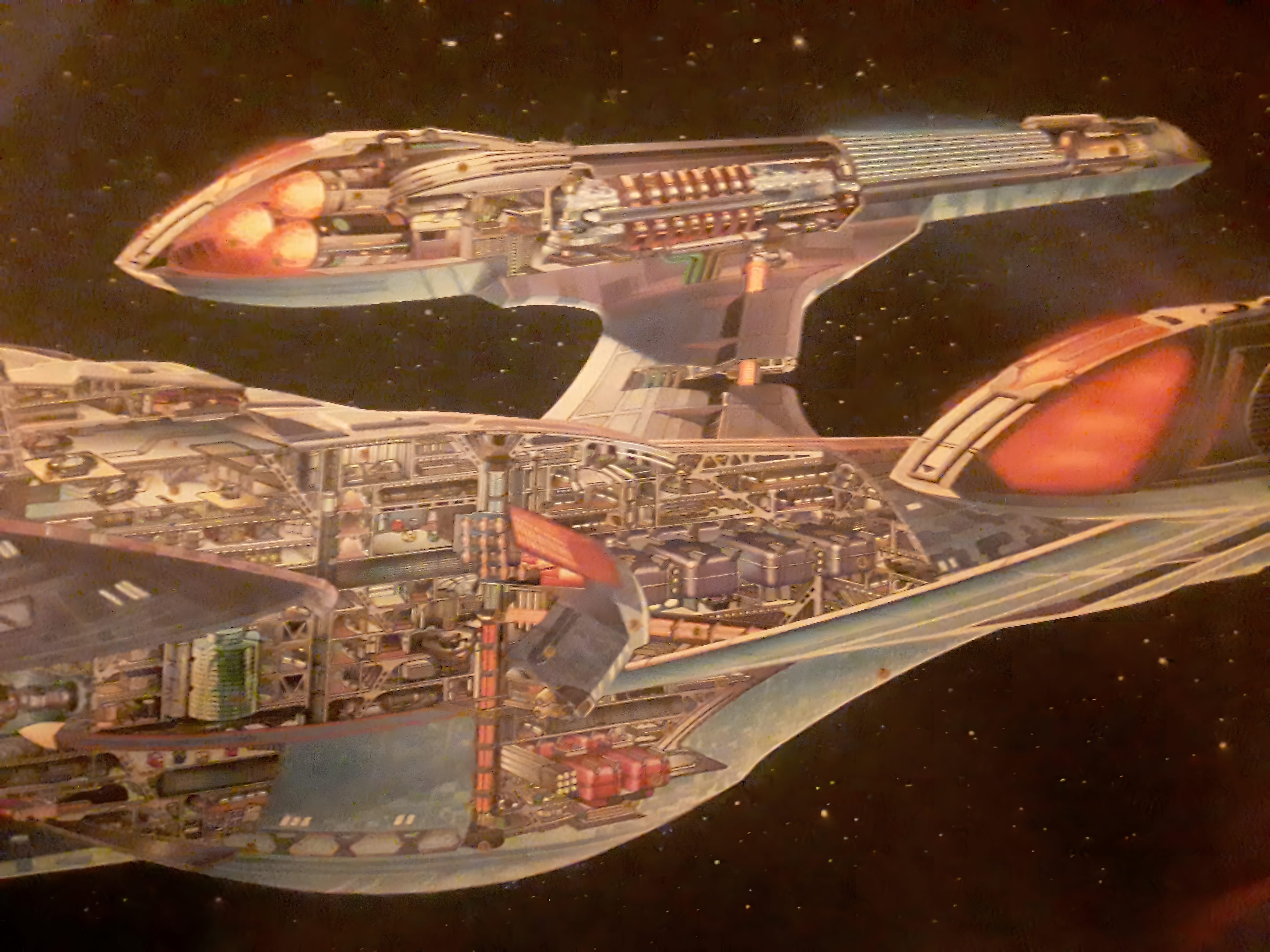
The Sovereign class was the Federation's answer to the lessons of the first Borg incursions: a flagship-grade explorer with the silhouette and fire-control of a warship, descended from the Excelsior and Ambassador lineages rather than the Galaxy programme. The figures below are the Daystrom Institute's published reference values for the Enterprise-E as launched, with refit changes noted; Bureau of Ships releases on the class remain partial, and the post-2379 configuration in particular is documented mainly through the ship's own engagement records.
| Parameter | Value |
|---|---|
| Class | Sovereign |
| Registry | NCC-1701-E |
| Launched | Stardate 49827.5 (2372), San Francisco Fleet Yards |
| Length | ~685 m (longer and sleeker than the 641 m Enterprise-D) |
| Decks | 24 (fewer than the Galaxy class despite the greater length) |
| Crew complement | ~855; no civilian families or children by deliberate Starfleet policy |
| Warp speed | Cruise warp 8; maximum recorded in excess of warp 9.9 |
| Phasers (as launched) | 12 phaser arrays |
| Phasers (post-2379 refit) | At least 16 phaser arrays |
| Torpedoes (as launched) | 5 launchers, including a rapid-fire forward quantum torpedo turret |
| Torpedoes (post-2379 refit) | ~10 launchers, forward and aft |
| Notable systems | First Enterprise equipped with an Emergency Medical Hologram; manual steering column on the bridge; ejectable warp core (used in the Briar Patch, 2375) |
| Embarked craft | Two shuttlebays; captain's yacht Cousteau; Argo shuttle with ground vehicle |
| Disposition | Out of service by 2386 after a classified mission; final fate unrecorded — see The Fate of the Enterprise-E |
Technical and Archive Notes
In its original configuration, the Enterprise-E had fewer decks than the Galaxy-class Enterprise-D and, by deliberate Starfleet policy, carried no civilian families or children. It had twelve phaser arrays and five torpedo tubes before later refits expanded its weapons fit.
By 2379, the ship had gained at least four more phaser arrays and five more torpedo tubes. Its facilities included deflector control, stellar cartography, hydroponics, sickbay, main engineering, two shuttlebays, the captain's yacht Cousteau, and the Argo shuttlecraft.
The ship could be controlled by a manual steering column on the bridge and was the first Enterprise equipped with an Emergency Medical Hologram.
Bureau of Ships design records describe the Sovereign-class as a successor configuration to the Excelsior and Ambassador lineages rather than a Galaxy refit, with a sleeker silhouette tuned for combat readiness; subsequent refits made further adjustments to the class hull profile.
The Enterprise-E was the rare replacement flagship that did not share its predecessor's class. Its sleeker Sovereign-class silhouette made the post-Enterprise-D era feel more tactical and faster.