Battle of Wolf 359: Locutus and the Federation Fleet Disaster
Browse the full topic archive for more internal links in this category.
The Battle of Wolf 359 in early 2367 was a decisive Borg victory over a Federation task force: thirty-nine starships destroyed, nearly eleven thousand killed or assimilated, with Locutus of Borg routing Starfleet tactics through Captain Jean-Luc Picard's assimilated knowledge. The USS Enterprise-D recovered Picard and used his residual link to disable the cube before it reached Earth.
Overview
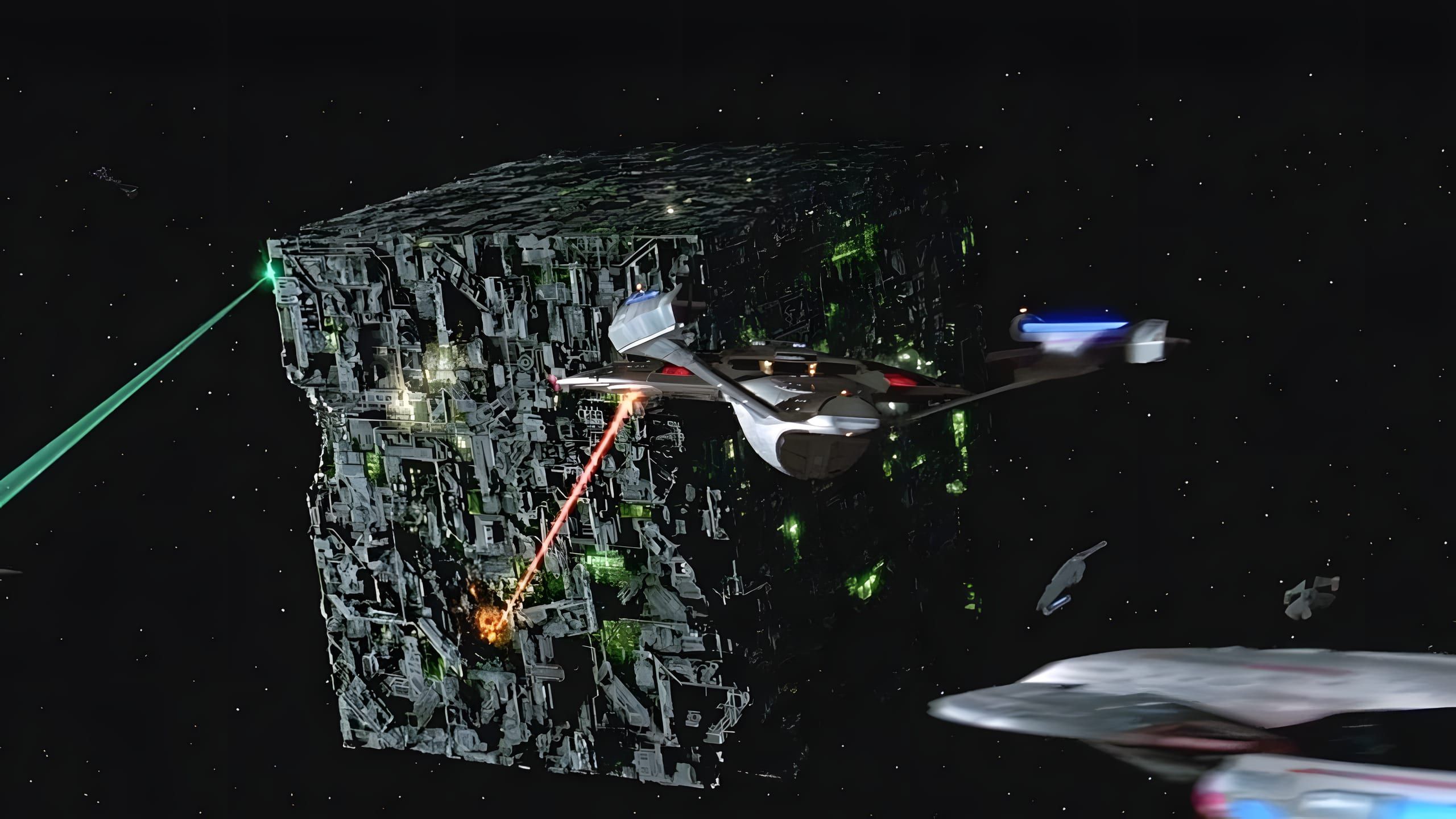
The Battle of Wolf 359 took place in early 2367 when a hastily assembled Federation fleet attempted to intercept a single Borg cube en route to Earth. The engagement ended in decisive Borg victory. Thirty-nine Starfleet starships were destroyed and nearly eleven thousand personnel were killed or assimilated.
Wolf 359 is inseparable from Jean-Luc Picard's assimilation as Locutus of Borg. The Borg did not merely attack Starfleet; they attacked with Starfleet knowledge extracted from one of its most experienced captains. The battle therefore belongs simultaneously to military history, intelligence compromise, and the personal record of a commander transformed into his civilization's adversary.
For Picard's archive, Wolf 359 is the wound that never fully closed. Survivors remembered Locutus's image on their viewscreens; Starfleet rebuilt doctrine around adaptive defense; and Picard's recovery aboard the USS Enterprise-D ended the immediate threat to Earth without erasing the moral accusation that a senior captain had been turned against his own fleet.
Approach and Assembly at Wolf 359
The crisis began after the destruction of the New Providence colony and the loss of the USS Lalo confirmed that a Borg cube was moving toward the core worlds. The USS Enterprise-D intercepted the vessel, but Picard was captured in the Paulson Nebula and assimilated before the cube resumed course for Sector 001.
Acting Captain William Riker pursued while Starfleet assembled every available hull. Rear Admiral J.P. Hanson coordinated the response from a command position near the battle zone. Lieutenant Commander Elizabeth Shelby, then Starfleet's lead Borg analyst, was among the officers who understood, too late, that conventional massed firepower had already failed once at System J-25.
The fleet gathered at Wolf 359 because the system's location offered a final intercept window before the cube could reach the Sol sector. Hanson and his staff expected a hard fight. None of the pre-battle estimates prepared Starfleet for a fight conducted with its own captain's tactical instincts inside the enemy network.
Shelby's briefing materials, later preserved in Starfleet Tactical archives, warned that Borg cubes adapted to weapons profiles within seconds of first contact. Hanson's staff nonetheless deployed a conventional intercept formation because no alternative doctrine had yet been validated at fleet scale.
Several captains requested permission to engage before Locutus opened communications. Hanson held the line long enough for the Borg broadcast to arrive. That delay cost the fleet its last chance to fight without the enemy knowing their names, their hull classes, and their preferred evasive patterns.
Survivor logs from the USS Gage and USS Firebrand describe the battle as lasting less than eleven minutes from first Borg weapons fire to the destruction of the last resisting formation element. The speed of the collapse shocked officers who had trained for sustained fleet engagements measured in hours.
Locutus and the Collapse of Federation Doctrine
When the cube entered weapons range, Locutus ordered the assembled ships to disarm. Federation captains refused. The Borg cube then engaged with adaptive defenses and targeting informed by Picard's command experience.
Subsequent analysis confirmed what survivors had felt in real time: the Borg did not need to learn Starfleet mid-battle. Through Locutus they already knew standard formation doctrine, authorized weapons profiles at given alert levels, and structural vulnerabilities of major hull classes including the Galaxy line. The cube's advantage was not firepower alone but foreknowledge.
Ships that held formation were overwhelmed within minutes. Phaser and photon torpedo spreads that should have stressed a single target were countered before they could force adaptation cycles. The engagement became a demonstration of how completely one assimilated officer could convert institutional habit into enemy advantage.
Locutus did not merely announce Borg demands. He identified individual ships by name, referenced their commanding officers' service histories, and ordered specific vessels to break formation in ways that exploited known command tendencies. The effect on morale was as severe as the effect on tactics.
Starfleet Academy later reconstructed the battle as a case study in compromised command intelligence. Cadets were required to memorize the Wolf 359 losses not as abstract numbers but as proof that one captured captain could convert peacetime exploration doctrine into a trap for an entire generation of line officers.
The Borg cube sustained damage during the engagement but remained operational enough to resume course for Earth. That fact haunted Hanson’s staff: the fleet had sacrificed thirty-nine ships and still failed to stop a single target.
Ships Lost at Wolf 359
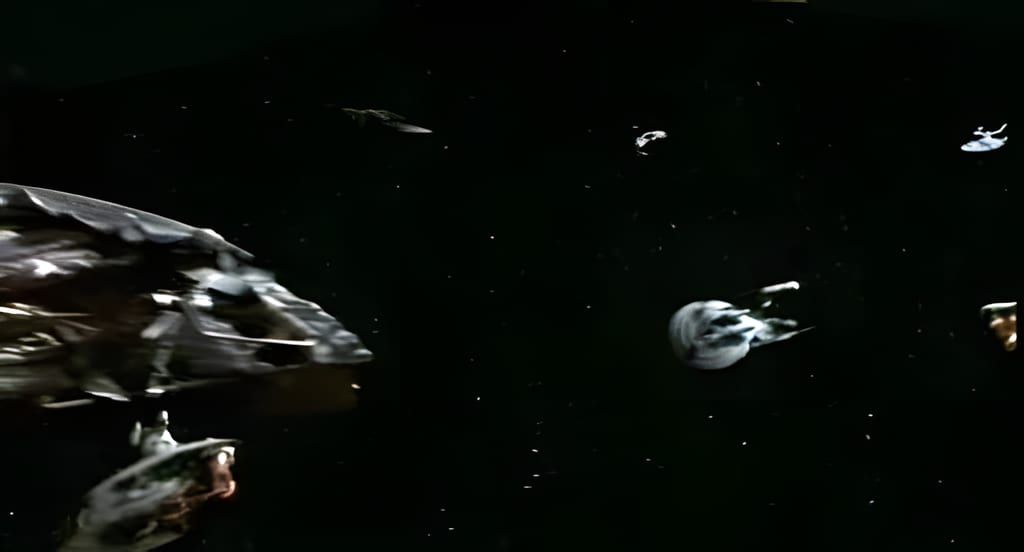
Declassified after-action summaries list thirty-nine Federation starships destroyed at Wolf 359. The toll included heavy cruisers, explorers, and support vessels drawn from across the fleet. Wreckage from the battle remained a navigation hazard for years afterward.
Among the most consequential losses was the USS Saratoga, a Miranda-class vessel on which Commander Benjamin Sisko served. Jennifer Sisko was killed when the ship was hit; Benjamin and Jake Sisko were among the survivors evacuated. Sisko's later record notes that he saw Locutus on the Saratoga's viewscreen in the seconds before impact, an image that recurred in his memory for decades.
The USS Melbourne, an Excelsior-class starship, was also destroyed. Commander William Riker had been offered command of the Melbourne shortly before the crisis and declined in order to remain aboard the Enterprise-D; the ship's loss became part of the personal cost borne by officers who survived because their postings changed at the last moment.
Medical teams at nearby starbases treated fewer than two hundred survivors from hulls large enough to launch escape pods. Assimilation accounted for a significant fraction of the missing; some personnel were recovered later from Borg drones identified in subsequent encounters.
Memorial plaques at Starfleet Headquarters list the battle date alongside the names of ships rather than individuals, because complete personnel accounting took years. Families of the lost continued to petition for fuller disclosure into the 2390s.
| Starship | Class / type | Notes |
|---|---|---|
| USS Ahwahnee NCC-71620 | Cheyenne | Destroyed in the opening exchange |
| USS Bellerophon NCC-62048 | Nebula | Total loss |
| USS Bonestell NCC-31600 | Oberth | Survey vessel pressed into the line; destroyed |
| USS Buran NCC-57580 | Challenger | Total loss |
| USS Chekov NCC-57302 | Springfield | Total loss |
| USS Constance | Registry unrecorded | Liam Shaw among ten crew rescued from the wreck |
| USS Firebrand NCC-68723 | Freedom | Survivor logs preserved in Starfleet Tactical archives |
| USS Gage NCC-11672 | Apollo | Survivor logs preserved in Starfleet Tactical archives |
| USS Kyushu NCC-65491 | New Orleans | Destroyed early in the engagement |
| USS Melbourne NCC-62043 | Excelsior | Command offered to William Riker before the battle; total loss |
| USS Princeton NCC-59804 | Niagara | Total loss |
| USS Roosevelt NCC-2573 | Excelsior | Total loss |
| USS Saratoga NCC-31911 | Miranda | Benjamin Sisko and Jake Sisko among survivors; Jennifer Sisko killed |
| USS Tolstoy NCC-62095 | Rigel | Total loss |
| USS Yamaguchi NCC-26510 | Ambassador | Destroyed in the final formation collapse |
Starfleet after-action accounting lists thirty-nine starships destroyed and approximately eleven thousand personnel killed or assimilated. Registries for many hulls remain incomplete in declassified archives; the table records the losses most frequently cited in survivor testimony and tactical reconstructions. For the officer whose captured knowledge directed the attack, see the account of Picard's assimilation as Locutus in the main biography.
Role in Picard's Career
Picard was absent from the Federation side of the battle because he had been converted into the Borg's voice and tactical conduit. That fact made Wolf 359 both a military disaster and a recurring moral accusation against him, even though he had not chosen assimilation.
Later confrontations with Benjamin Sisko, Norah Satie, and Liam Shaw show how Picard's recovery did not end the public meaning of Locutus. Survivors and investigators continued to read the battle through his unwilling role in it.
Within Picard's own correspondence, Wolf 359 marks the boundary between the exploratory confidence of his early USS Enterprise-D command and a later career shaped by the knowledge that Starfleet's most trusted officers could be converted into weapons against the Federation.
Recovery and the Battle Over Earth
The Enterprise-D pursued the cube from Wolf 359 and intercepted it near Earth. Riker and Shelby developed a plan to separate the saucer and stardrive sections, disrupt Borg sensors with an antimatter spread, and insert a boarding team to recover Locutus.
Lieutenant Commander Data and Lieutenant Worf transported Picard aboard and severed his immediate environmental link to the Collective. Data then used a controlled neural connection to reach the cube through Picard's transceiver and issue a regenerate command that disabled the vessel's combat systems.
Picard was returned to duty after removal of surface implants, but the battle's casualties could not be undone. Starfleet had learned, at catastrophic cost, that the Borg threat required new doctrine, new hull designs, and a permanent place in training curricula for the name Wolf 359.
Crusher's medical report on Picard noted that surface implants could be removed but that neural integration ran deeper than visible cybernetics. That finding, classified at the time, foreshadowed the biological complications that would surface again during the Frontier Day crisis.
Public Federation announcements after the cube's destruction emphasized victory at Earth. Internal reports balanced that message with the Wolf 359 accounting, ensuring that Starfleet leadership could not treat the campaign as an unqualified success.
Strategic and Historical Significance
Wolf 359 exposed Starfleet's lack of readiness against the Borg. Line formations, conventional firepower, and existing defensive doctrine failed against an enemy that could adapt faster than Starfleet could coordinate and that could exploit captured command knowledge without pause.
Fleet rebuilding after the battle included development of more heavily armed defensive concepts, including the Defiant-class project. The battle became a reference point for later discussions of Borg tactics, Dominion War losses, and Earth security policy.
Historically, Wolf 359 is the moment the Borg ceased to be a distant frontier rumor and became a structural assumption of Federation planning. No subsequent Borg crisis could be discussed without measuring it against the losses at Wolf 359 and the figure of Locutus on the viewscreen.
The Defiant-class project, though already under discussion, received priority funding after Wolf 359. Commanders who had argued for smaller, heavily armed hulls cited the battle as proof that explorer-class platforms could not serve as the Federation's primary defensive answer to the Borg.
Benjamin Sisko's assignment to Deep Space Nine and later command of the USS Defiant connected directly to the battle's aftermath. His personal loss and Starfleet's tactical response shared the same origin date.
Legacy
The battle's legacy remained personal for survivors and institutional for Starfleet. Sisko's grief, Shaw's survivor guilt, and Picard's own trauma show that Wolf 359 was not closed by the destruction of the cube near Earth.
For Picard, Wolf 359 became the price of being transformed into Locutus: a disaster he did not choose but could never fully leave behind. The Federation historical record treats the battle as closed militarily but not morally, because the fleet that fought there fought an enemy speaking with its own captain's voice.
Annual memorial observances at Starfleet Academy include a reading of the thirty-nine ship names. Cadets who graduate without hearing those names are rare; the battle is treated as foundational trauma for the institution that trained the officers who fought there.