The Borg Collective: Assimilation, Locutus, and Picard's Longest Conflict
Browse the full topic archive for more internal links in this category.
Overview

The Borg Collective was a distributed civilization organized through a hive mind, linking drones across subspace into a single operational will. Its political structure did not resemble a federation, empire, or alliance; it treated individuality as inefficiency and expansion as correction.
For Starfleet, the Borg were not simply another hostile power. Their method of assimilation converted people, ships, and knowledge into instruments of further conquest. Picard's record with the Collective therefore sits at the intersection of military history, trauma, and Federation ethics.
Role in Picard's Career
Picard's first major Borg encounter came after Q forced the USS Enterprise-D into contact with a Borg cube near System J-25. That event exposed the Federation to an adversary whose tactical analysis, adaptive defenses, and indifference to negotiation exceeded normal Starfleet planning assumptions.
The Collective's later capture of Picard and creation of Locutus of Borg turned a starship captain into a strategic asset against his own civilization. Picard's command history cannot be separated from that conversion, because the Borg used his knowledge of Starfleet operations to increase the cost of their advance.
Key Events or Actions
The Borg attack that culminated at Battle of Wolf 359 demonstrated the operational value of assimilation. Through Locutus, the Collective gained access to Picard's tactical experience, Starfleet protocols, and command instincts, allowing a single cube to devastate a Federation task force.
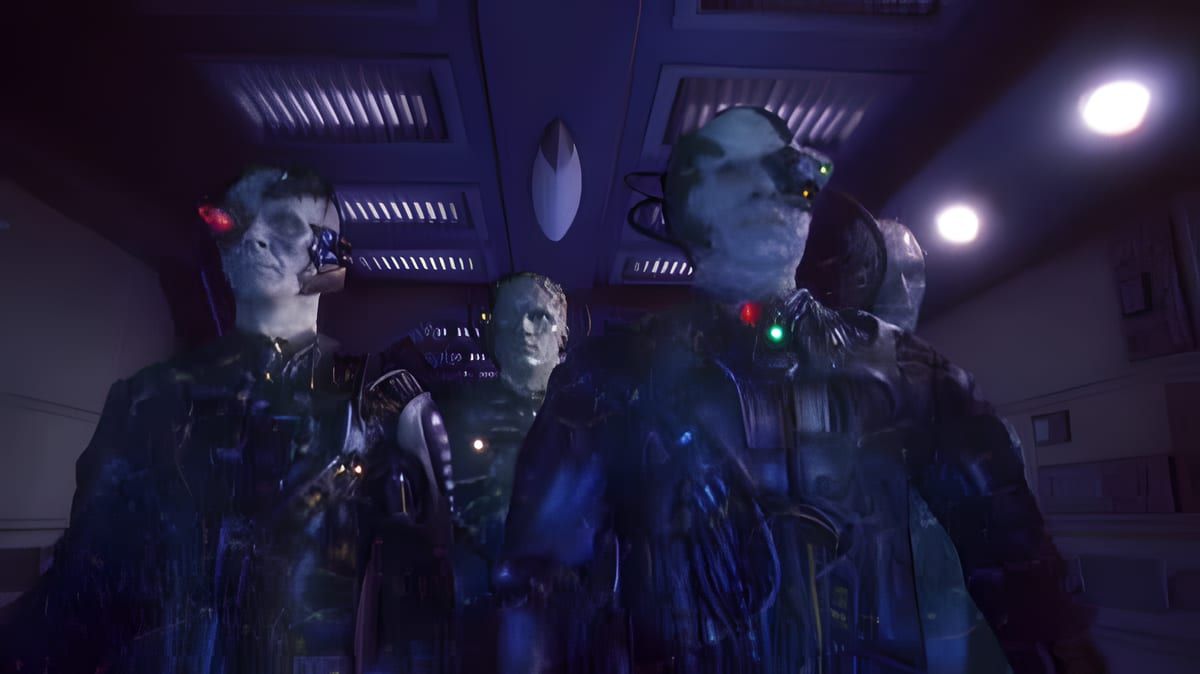
The Enterprise-D crew eventually used Picard's remaining connection to the Collective as a conduit, issuing commands that disrupted the attacking cube. The same network that made the Borg formidable also created a vulnerability when Starfleet could reach it through an assimilated captain.
Decades later, the Collective's residual alterations to Picard's biology became part of the Frontier Day crisis. Borg-modified genetic material, transmitted through compromised Starfleet transporter systems, turned young officers into receivers for a collective signal and made Picard's family history a matter of fleet security.
Strategic or Historical Significance
The Borg forced Starfleet to confront an enemy that did not require hatred, ideology, or conquest in the familiar sense. The Collective's violence was administrative: classification, extraction, alteration, and redeployment.

Starfleet operations involving the Borg also complicated Federation ideals. Former drones such as Hugh raised questions about personhood after assimilation, while Picard's own recovery showed that liberation from the Collective did not erase what the Collective had taken or left behind.
Legacy
The Borg legacy in Picard's life stretches from System J-25 to Wolf 359, from the Enterprise-E's defense of Earth to the cube hidden at Jupiter. No other adversary so thoroughly joined Picard's public command record to his private body and family.
Historically, the Collective remains the Federation's clearest warning about efficiency without conscience. Its defeat depended not only on superior firepower, but on the persistence of individual decision inside systems designed to erase it.