Veridian III: Enterprise-D Crash Site and Picard's Nexus Crisis
Browse the full topic archive for more internal links in this category.
Overview
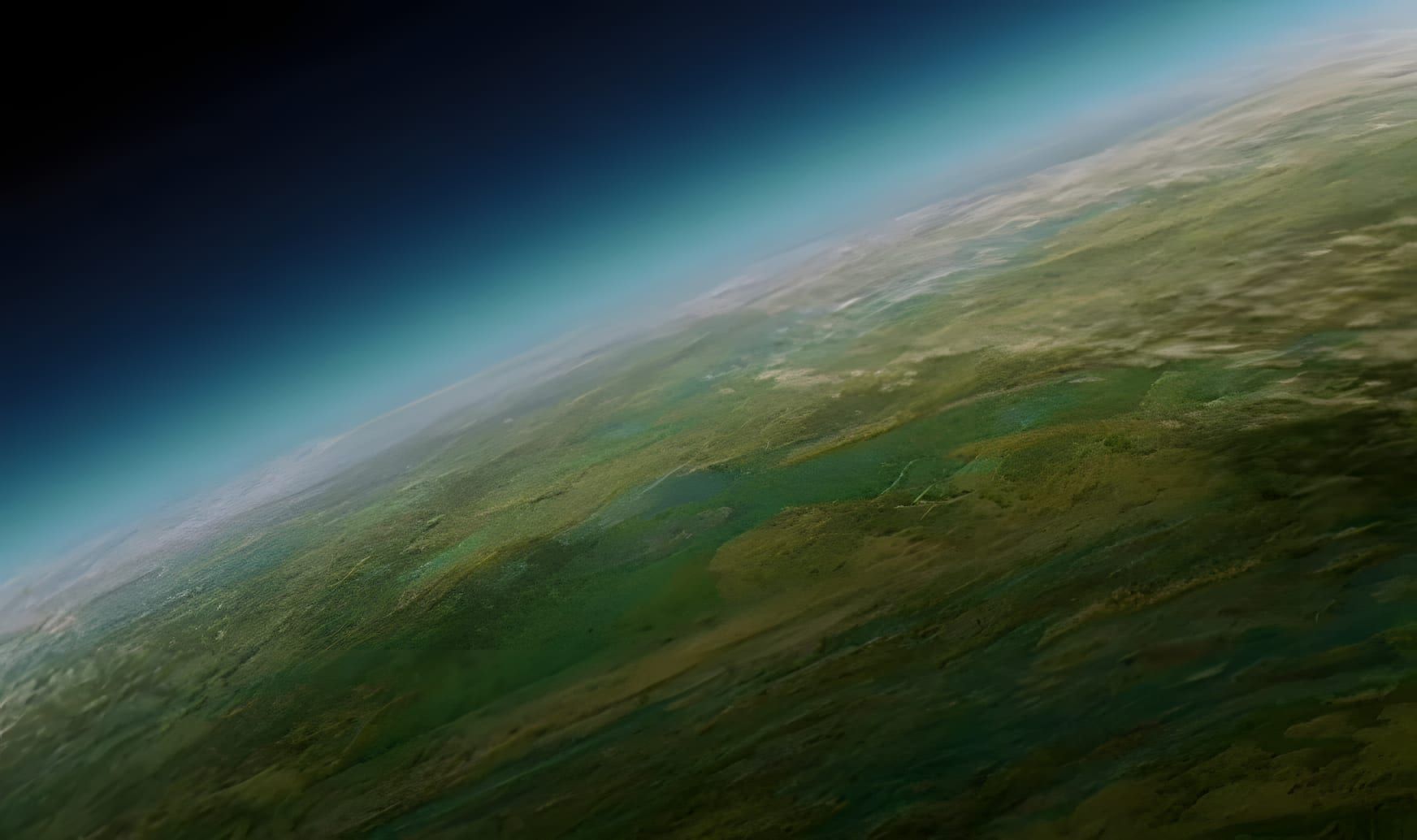
Veridian III was an uninhabited M-class planet in the Veridian system. Its mountainous and vegetated surface became the site of the USS Enterprise-D saucer crash, the final confrontation with Tolian Soran, and the death of James T. Kirk.
For Picard's career, Veridian III marks the end of the Galaxy-class flagship era. The planet is a location where command, temporal anomaly, ship loss, and historical succession converged in a single afternoon.
The system's stakes extended beyond Veridian III itself. Soran's weapon threatened Veridian IV, a world with a pre-warp population that would have been destroyed if the star had collapsed. Picard's intervention therefore combined personal rescue with Prime Directive-level consequence.
The Veridian System and Soran's Objective
The Veridian system contained at least four planets orbiting a single main-sequence star. Veridian III was uninhabited; its neighbor Veridian IV supported a pre-industrial humanoid society of approximately 230 million people. The collapse of the Veridian star would have destroyed every world in the system within minutes of the shock front's arrival.
Tolian Soran had lost his family to the Nexus, a temporal energy ribbon he became obsessed with re-entering. His plan required destroying the Veridian star so that gravitational conditions would bring the Nexus to Veridian III at a predictable moment.
Picard traced Soran from the Amargosa observatory after a stellar collapse demonstration proved the scientist could collapse stars on schedule. The investigation led the Enterprise-D to Veridian III, where Soran had prepared a trilithium weapon platform on the surface.
Veridian IV's 230 million inhabitants could not be evacuated in time if Soran succeeded. Picard therefore faced a problem measured in minutes: stop the launch, preserve the star, and prevent a civilization-ending event in a system he had entered under distress protocols.
Veridian IV's pre-warp population could not be warned through conventional means without violating the Prime Directive. Picard therefore had to stop Soran without relying on local cooperation or planetary defenses.
Soran's trilithium compound represented stolen research with stellar-scale effect. His demonstration at Amargosa had already destroyed one star; Veridian was intended to be the final rehearsal before he entered the Nexus permanently.
Battle in Orbit and the Saucer Crash
While Picard beamed to the surface to negotiate with Soran, the Enterprise-D fought a renegade Klingon Bird-of-Prey commanded by Lursa and B'Etor in orbit. The sisters used information taken from Geordi La Forge's VISOR feed to match the Enterprise's shield frequency.
Their D12-class vessel inflicted severe damage before the Enterprise crew exploited defective plasma coils on the Klingon ship and destroyed it. The victory in orbit was pyrrhic: magnetic interlocks in the Enterprise's warp core failed, triggering an unavoidable breach.
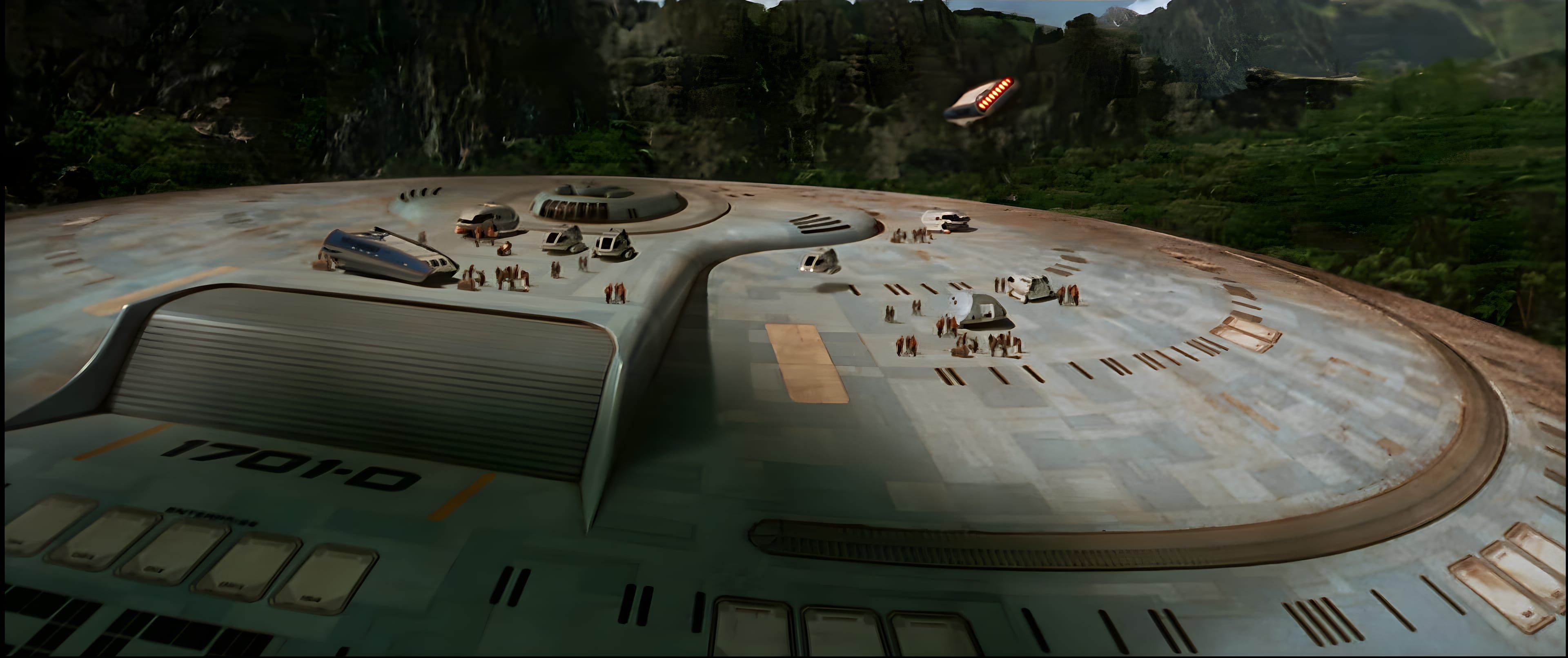
Commander William Riker ordered evacuation from the stardrive section to the saucer. The stardrive section exploded; the shock wave disabled the saucer and forced it into Veridian III's atmosphere. Lieutenant Commander Data rerouted auxiliary systems to lateral thrusters, allowing a survivable crash landing with minimal casualties.
La Forge's VISOR compromise remains a case study in intelligence leakage through assistive technology. The Duras sisters did not need to board the Enterprise; they needed only the shield frequency broadcast through a channel La Forge trusted.
Casualty reports from the saucer crash listed injuries but few deaths, a testament to Riker's evacuation discipline and Data's last-second flight corrections. The ship itself was considered a total loss until La Forge undertook restoration decades later.
Picard, Kirk, and the Nexus
On the surface, Picard failed to stop Soran through conventional negotiation. Both men entered the Nexus, where Picard encountered Kirk and persuaded him to leave the temporal paradise to stop the launch.
Working together across the ribbon's reality distortions, Picard and Kirk prevented Soran from firing the weapon. Kirk died in the effort. Picard beamed out with the missile's threat neutralized and the Veridian star preserved.
The cooperation between two captains of the Enterprise name closed one lineage of command and opened another: the Sovereign-class USS Enterprise-E would carry Picard forward while the Galaxy-class flagship lay broken on Veridian III's surface.
Kirk's presence inside the Nexus gave Picard an ally who understood sacrifice without needing a briefing on Soran's physics. Their cooperation bridged two centuries of Enterprise command tradition in a single surface action.
Picard later described the Nexus experience as temptation rather than reward: a lifetime offered without cost, which he refused because the cost would have been paid by Veridian IV's inhabitants.
Recovery of the Saucer and Later Significance
Starfleet later recovered the saucer section from Veridian III to prevent advanced wreckage from contaminating Veridian IV's development. Commodore Geordi La Forge spent twenty years restoring the hull at the Fleet Museum, rebuilding the secondary section with components from the USS Syracuse.
By Frontier Day in 2401, the restored Enterprise-D was operational again and became the one major Starfleet vessel not compromised by the Borg-linked fleet network. Picard resumed command and used the ship to help save Earth from the Borg Queen's cube at Jupiter.
What began as wreckage on Veridian III therefore became a preserved instrument of Picard's final Borg victory. The planet's memorial significance changed from ending to continuation.
Prime Directive officers debated for years whether removing the saucer was itself an intervention. The consensus held that advanced wreckage posed greater cultural risk than controlled recovery.
When the restored Enterprise-D emerged from Hangar Bay 12 in 2401, Veridian III's crash site became prologue rather than finale—a reminder that Galaxy-class engineering could survive even stellar-scale command crises.
Legacy
Veridian III became a memorial site in several senses: the place where Kirk died, the resting point of the Enterprise-D saucer, and the end of one chapter of Picard's command.
For searchers asking what happened to the USS Enterprise-D, Veridian III is the first answer: destroyed in orbit, crashed on the surface, recovered, rebuilt, and returned to service when the Federation needed an uncompromised flagship.
Its later significance proves that ship loss in Picard's record rarely means permanent absence. The Enterprise name and the Enterprise-D hull both survived Veridian III in different forms.
Kirk's burial on Veridian III gave the planet a permanent place in Federation memorial culture. Picard's later return to a restored Enterprise-D connected Veridian's ending to Frontier Day's beginning across thirty years of command history.