USS Enterprise-D
The Galaxy-class Federation flagship that turned Picard's command into legend, then returned decades later for one last impossible rescue.
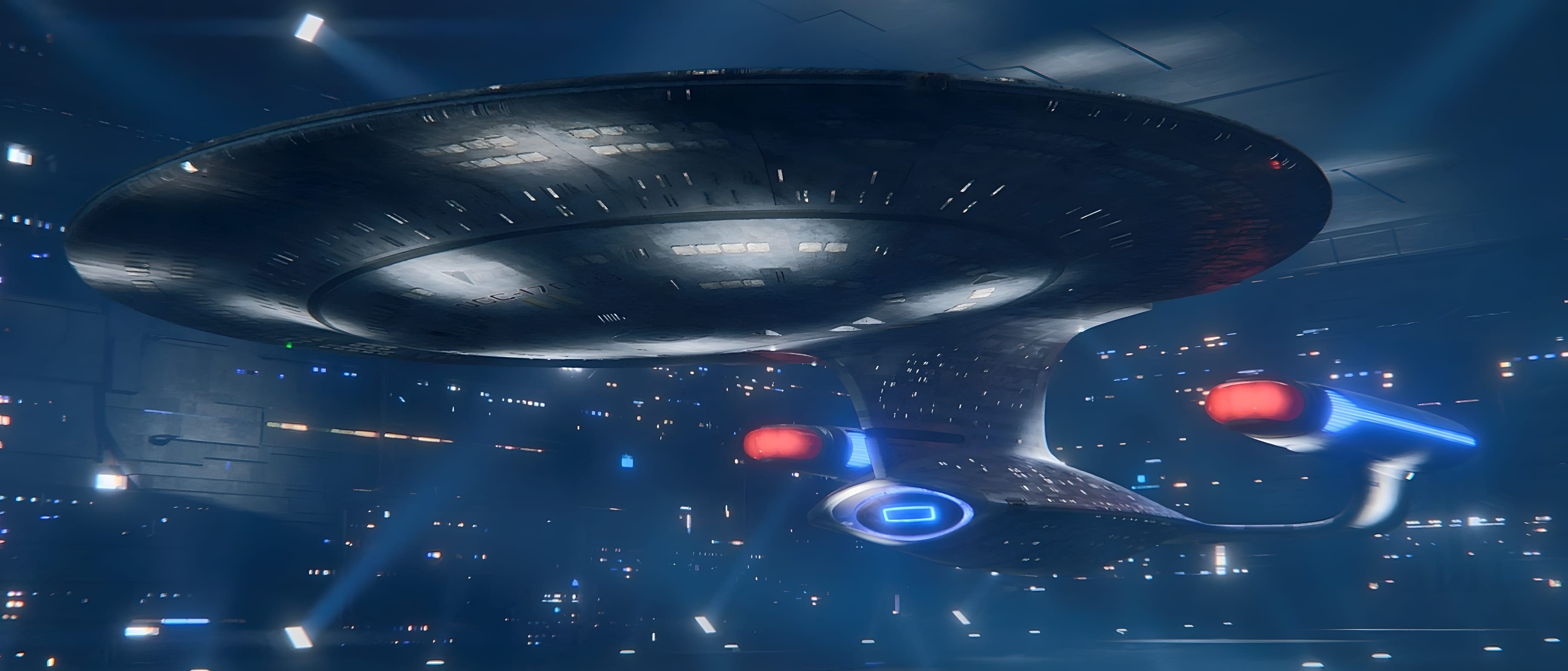
Service dossier
- Registry / identity
- NCC-1701-D
- Class / type
- Galaxy-class Federation starship
- Picard's role
- Commanding officer; returned to command in 2401
- Recorded period
- Flagship service from 2363 to 2371; restored for the 2401 Borg crisis; museum ship by 2402
Why this ship matters
The USS Enterprise-D was the fifth Federation starship to bear the name Enterprise, and from 2363 to 2371 it served as the Federation flagship under Captain Jean-Luc Picard.
The ship carried Picard through Q's trial of humanity, first contact with the Borg, the Klingon Civil War, the Cardassian border crisis, the discovery of the ancient humanoid message, and the final mission that ended with the saucer section crashed on Veridian III.
Recovered and rebuilt by Geordi La Forge at the Fleet Museum, the Enterprise-D returned to action in 2401 as the one major Starfleet vessel not compromised by the Borg-linked fleet network. Picard resumed command and used it to help save Earth.
Construction and Commissioning
The Enterprise-D was built at Utopia Planitia Fleet Yards in orbit of Mars, a massive construction effort involving thousands of specialists. Commander Quinteros supervised construction, while Dr. Leah Brahms was responsible for much of the warp propulsion system design.
Some components were derived from technology originally developed on the USS Pegasus. During construction, one nacelle tube became the site of a murder-suicide by Walter Pierce, whose telepathic imprint remained hidden in the ship until 2370.
The ship launched from Mars in 2363 and was commissioned later that year. Final systems completion and shakedown took place at Earth Station McKinley, where Jean-Luc Picard took command on orders from Rear Admiral Norah Satie.
Early Flagship Years
The ship's first mission to Farpoint Station brought it into direct contact with Q and included the first high-warp saucer separation. Soon afterward, the Traveler propelled the ship to the distant M-33 galaxy and then to the edge of known experience, making the new flagship a test case for realities far beyond routine exploration.
In 2364, the Enterprise received a computer refit and was hijacked from Starbase 74 by the Bynars, who used the ship to save their own damaged planetary computer. That same year, the ship encountered many of the species and phenomena that defined its early exploration record, including the Ferengi, the Crystalline Entity, Armus, the Edo, and the Farpoint entities.
The ship also became home to a mixed crew and civilian population. It carried more than one thousand crew and passengers, ran schools and day care centers, used Ten Forward as its social center, and supported holodecks, families, scientists, diplomats, and children alongside Starfleet officers.
Borg, Klingons, and Starfleet Crises
The Enterprise-D made Starfleet's first major contact with the Borg in 2365 after Q hurled the ship into their path. The Borg removed sections of Decks 4, 5, and 6 for analysis, killing eighteen people and giving the Federation its first warning of the collective threat.
During the Borg incursion of 2366 and 2367, the ship was heavily damaged after Picard was captured and assimilated as Locutus. Main engineering was decompressed, the main deflector was converted into a last-ditch weapon, and the saucer was damaged during the final fight over Earth. The damage required a major refit at Earth Station McKinley.
In 2367, Picard used the Enterprise as the command ship for an ad hoc Starfleet armada during the Klingon Civil War. The fleet formed a tachyon detection grid that exposed cloaked Romulan support for the House of Duras and helped preserve Gowron's claim to the chancellorship.
The ship's service also included Captain Edward Jellico's temporary command during Picard's covert Cardassian mission, Riker's field promotion during the Borg crisis, Data's and Beverly Crusher's temporary commands, and the steady executive command of William Riker throughout most of Picard's tenure.
Exploration and Notable Missions
The Enterprise-D repeatedly survived disasters that would have ended lesser ships. It struck a quantum filament in 2368, was trapped in a temporal causality loop near the Typhon Expanse, was hijacked by Ferengi under DaiMon Lurin, and nearly lost dangerous trilithium resin during a baryon sweep at the Remmler Array.
The ship was among the first Starfleet vessels to dock at newly commissioned Deep Space 9, delivering Starfleet personnel and Danube-class runabouts before later returning to help repair Bajoran aqueduct systems damaged during the Cardassian Occupation.
In 2369, the crew pieced together Dr. Galen's research and uncovered a message from the ancient humanoids, the first humanoid species in the Milky Way. That discovery made the Enterprise central to one of the Federation's most important archaeological and scientific breakthroughs.
In 2370, the ship briefly used the illegal phasing cloak recovered from the USS Pegasus to escape an asteroid where a Romulan vessel had trapped it. The same year brought the D'Arsay archive, Barclay's Protomorphosis Syndrome, an emergent lifeform born through the ship's systems, and a patrol of the Demilitarized Zone after Miles O'Brien was captured by Cardassians.
The Enterprise-D made or participated in numerous first contacts, including open contact with the Ferengi, Borg, Tamarians, exocomps, Malcorians, Cytherians, and several noncorporeal or unusual lifeforms. Its exploration record was as important as its combat record.
Fate and Recovery
What happened to the USS Enterprise-D? The ship was destroyed in 2371 over Veridian III: battle damage forced an unstoppable warp core breach, the stardrive section was lost in the explosion, and the evacuated saucer section was thrown into the atmosphere and crash-landed on the planet's surface. Most of the crew survived, but the ship was struck from the active rolls as lost.
That was not the end of the hull. Starfleet quietly recovered the saucer from Veridian III to prevent contamination of the pre-warp civilization on neighbouring Veridian IV, and the wreck passed into the keeping of the Fleet Museum. There, over roughly twenty years and largely in secret, curator Commodore Geordi La Forge restored the ship in Hangar Bay 12—undoing the final refits, rebuilding the lost secondary hull with components from the USS Syracuse—until the Enterprise-D was not a museum piece but a working starship.
The restoration was vindicated in 2401, when the Borg compromised every networked ship in the fleet during the Frontier Day crisis and the old, unnetworked Enterprise-D flew again under Picard's command to destroy the Borg cube at Jupiter. In 2402 the ship was retired a second time, to a place of honour at the Fleet Museum between the Enterprise-A and the Stargazer NCC-2893. The full record of both endings—the crash and the comeback—follows below.
Destruction at Veridian III
In 2371, the Enterprise responded to a distress call from the Amargosa observatory and became involved in Doctor Tolian Soran's attempt to redirect the Nexus energy ribbon. The investigation led the ship to Veridian III, where the Duras sisters' Bird-of-Prey exploited La Forge's compromised VISOR feed to penetrate the ship's shields.
The battle ruptured magnetic interlocks and led to an unavoidable warp core breach. Riker ordered evacuation from the stardrive section to the saucer, and La Forge and Doctor Crusher completed the evacuation with only a minute to spare.
The stardrive section was destroyed, and the resulting shock wave disabled the saucer and forced it into Veridian III's atmosphere. Data rerouted auxiliary systems to the lateral thrusters, allowing the saucer to level out enough for a survivable crash landing. Casualties were minimal, but the ship was considered lost.
The surviving crew was rescued by Starfleet vessels including the USS Farragut. Picard believed the Enterprise-D would not be the last ship to bear the name, and that proved true when the Sovereign-class USS Enterprise-E continued the line in 2372.
Restoration and Final Mission
Because of Prime Directive concerns, the crashed saucer section was eventually recovered from Veridian III and taken to the Fleet Museum. As museum curator, Commodore Geordi La Forge spent twenty years restoring the ship in Hangar Bay 12, undoing the last 2371 refits and rebuilding the secondary hull with parts from the USS Syracuse.
By Frontier Day in 2401, the restored Enterprise-D was operational again, though La Forge still considered some issues unfinished. When the Borg used Starfleet's linked fleet network to compromise modern ships, the older Enterprise became exactly what Picard and his crew needed: a powerful starship outside the network.
Picard, Riker, Worf, La Forge, Data, Beverly Crusher, and Deanna Troi took the ship back into action at Jupiter. The crew located a Borg cube hidden in the Great Red Spot, where Jack Crusher was being used as the command signal controlling the assimilated young officers of Starfleet.
Picard, Riker, and Worf boarded the cube to find Jack and the beacon coordinates while Data flew the Enterprise through the cube's superstructure. Beverly manually targeted defensive turrets, the ship destroyed the beacon with phasers and photon torpedoes, and Troi guided the ship to rescue the away team just before the cube was destroyed.
The victory broke Borg control over Starfleet and ended the immediate threat to Earth. In 2402, the restored Enterprise-D was placed on display at the Fleet Museum in a place of honor between the USS Enterprise-A and the USS Stargazer.
Legacy and Design Notes
The Enterprise-D left a deep personal legacy. Riker mourned the command he never got to inherit, Worf considered the ship so dear that its loss nearly drove him from Starfleet, and Picard later kept its memory close enough that a broken model of the ship helped him recognize the danger of his obsession during the Borg takeover of the Enterprise-E.
Its reputation lasted well beyond its destruction. Later Starfleet officers, Klingons, Protostar trainees, museum visitors, and even Frontier Day souvenir sellers remembered the ship as one of the defining vessels of the 24th century. By 2401, Starfleet Academy displayed it among historic ships, and by 2402 its restored bridge gave Picard, Riker, and La Forge a final chance to reflect on what the ship had meant to them.
Federation design archives credit Andrew Probert with the Enterprise-D's lineage from earlier refit concepts for the Enterprise. Surviving model records describe six-foot, two-foot, and four-foot study miniatures, plus a large saucer reconstruction used to document the Veridian III crash.
Early registry proposals considered placing a later-suffix Enterprise in the late 25th century, but final Starfleet records settled on NCC-1701-D. The ship became one of the most frequently documented vessels in Federation history.