USS Enterprise-G (NCC-1701-G)
Constitution III-class light cruiser, registry NCC-1701-G; the former USS Titan-A, rechristened in 2402 to carry the Enterprise name after helping save Starfleet from the Changeling–Borg conspiracy on Frontier Day.
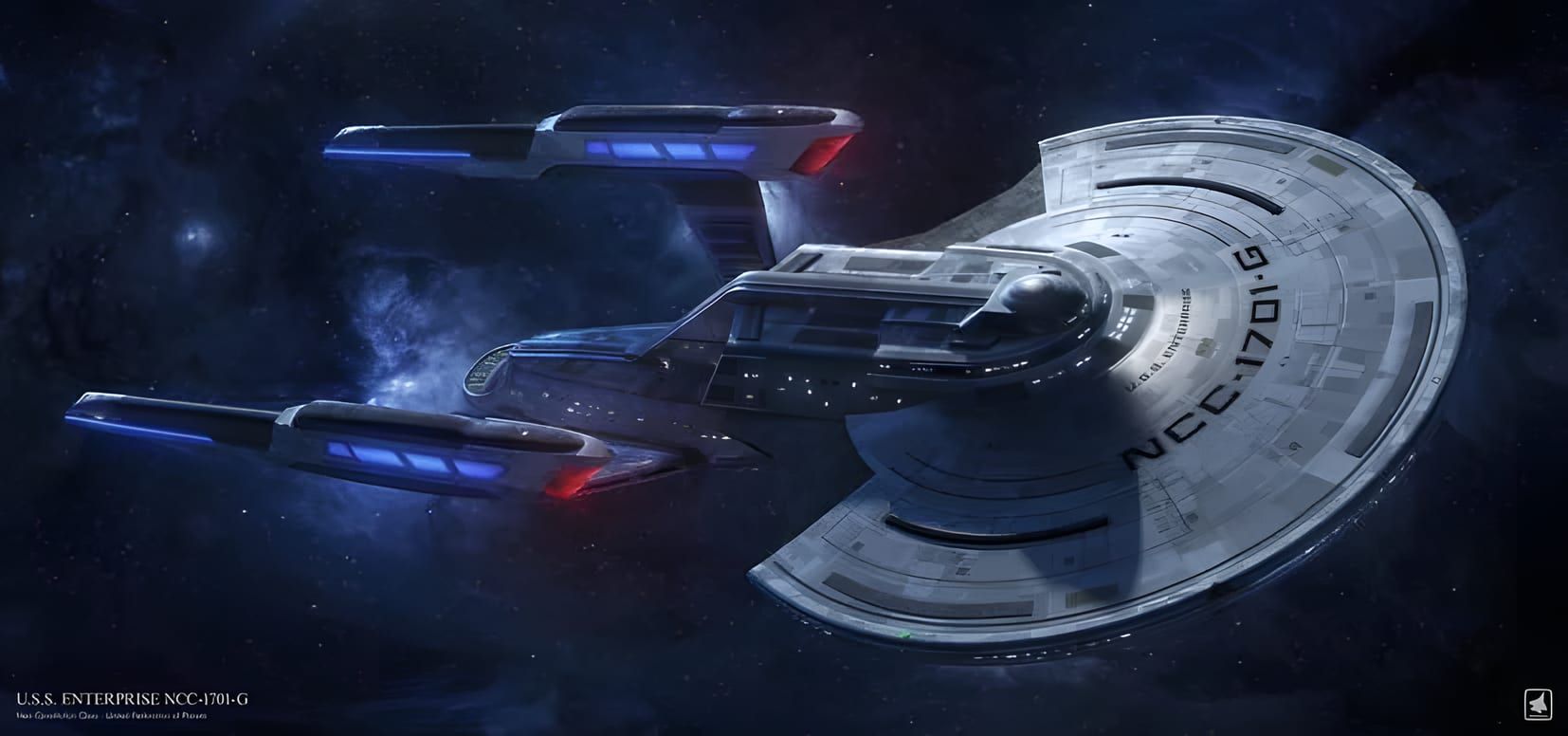
Service dossier
- Registry / identity
- NCC-1701-G (2402–present); formerly USS <em>Titan</em>-A NCC-80102-A (2396–2401)
- Class / type
- Constitution III-class starship (sometimes called "Neo-Constitution"); light cruiser / light explorer configuration
- Picard's role
- Legacy honoree; the ship was rechristened at the close of Frontier Day with Picard's son Jack Crusher among the new command crew
- Recorded period
- <em>Titan</em>-A commissioned 2396 under Captain Liam Shaw; rechristened <em>Enterprise</em>-G in 2402 under Captain Seven of Nine
Why this ship matters
The USS Enterprise-G, NCC-1701-G, is the eighth Federation starship to carry the Enterprise name and the first ever to be physically smaller than its immediate predecessor. The hull is a Constitution III-class light cruiser; the ship it replaced, the Enterprise-F, was an Odyssey-class capital ship roughly the size of a small city. The choice was deliberate—Starfleet emerged from Frontier Day with its industrial spine cracked, its officer corps haunted by Borg assimilation, and a fleet badly in need of the legacy reassurance that only the Enterprise name could provide.
Before 2402 the same hull served as the USS Titan-A, NCC-80102-A, under Captain Liam Shaw. The Titan-A spent five years on routine missions before the crisis of 2401 dragged it into rescuing Beverly and Jack Crusher from Vadic's Shrike, hunting a Changeling conspiracy through Daystrom Station and the Chin'toka scrapyard, and surviving the Borg's transporter-DNA assimilation of every Starfleet officer under twenty-five.
Rechristened in honour of Picard's Enterprise-D command crew and the Titan-A's role in ending the assimilation, the Enterprise-G carries an unusual command lineage: Captain Seven of Nine, a former Borg drone; Commander Raffi Musiker, the former intelligence officer cashiered after Picard's resignation; Ensign Jack Crusher, Picard's son, in the unprecedented post of special counselor to the captain; and Lt. Sidney La Forge—daughter of Geordi La Forge—at the helm.
The ship's first formal mission was a shakedown cruise around a red giant, during which Q reappeared to Jack Crusher to tell him that the trial of humanity was over for his father and had only just begun for him. The encounter is recorded in Jack Crusher's personal log and in later correspondence between him and his father.
Taken together, the Enterprise-G's existence is a record of what Starfleet could still rebuild after Mars (2385) and Frontier Day (2401), what it could no longer afford to build at scale, and which legacy names the Federation chose to prioritise when industrial capacity remained constrained.
NCC-1701-G: Registry, Class, and the Constitution III Lineage
The literal designation NCC-1701-G ties this ship to a lineage the Federation has carried, by registry, since 2245. The hull beneath the registry, however, is younger and stranger: a Constitution III-class space-frame originally numbered NCC-80102-A and commissioned in 2396 as the USS Titan-A. The rechristening in 2402 transferred the historic 1701 lineage onto a hull that had already spent six years answering to another name and another captain. The eight Enterprises sit in unbroken sequence in the registry but in very different sizes, classes, and political moments.
The Constitution III is a deliberate echo of the original 1701 hull form—saucer, secondary hull, twin nacelles, deflector dish on the forward face of the engineering hull. Some Starfleet engineering literature uses the informal name "Neo-Constitution"; the official class name carries the lineage claim Starfleet wanted on the side of the hull. The published Bureau of Ships specification records the overall length as less than that of the Enterprise-D (641 m), making the Enterprise-G the first Enterprise in registry history to be physically smaller than its immediate predecessor.
The class change is also a record of what Frontier Day cost. Utopia Planitia was still rebuilding from the 2385 Mars attack; replacement capital construction had collapsed; the fleet's modernisation effort had been quietly retreating to refits and smaller hulls for years. A Constitution III is what the post-Mars, post-Frontier-Day Federation could actually build at scale, and what Starfleet could plausibly assign to a smaller crew once the F-class era of giant capital ships had passed.
| Name | Registry | Class | Service period |
|---|---|---|---|
| USS Enterprise | NCC-1701 | Constitution | 2245–2285 |
| USS Enterprise (refit) | NCC-1701-A | Constitution (refit) | 2286–2293 |
| USS Enterprise | NCC-1701-B | Excelsior | 2293–c. 2329 |
| USS Enterprise | NCC-1701-C | Ambassador | 2332–2344 |
| USS Enterprise | NCC-1701-D | Galaxy | 2363–2371 |
| USS Enterprise | NCC-1701-E | Sovereign | 2372–c. 2381 |
| USS Enterprise | NCC-1701-F | Odyssey | c. 2381–2401 |
| USS Enterprise | NCC-1701-G | Constitution III | 2402– |
USS Enterprise-G Bridge Layout
The Enterprise-G's bridge inherits its layout, more directly than most legacy Enterprise bridges, from another active ship: the redesigned USS Stargazer NCC-82893. Starfleet's standard practice on the Constitution III build reused the Stargazer's deck plan with minor refit, and the result shows in the floor layout. The captain's chair sits centred on a slightly raised dais. The conn (Lt. Sidney La Forge) is forward and to the captain's left; tactical sits at a wraparound rail behind the chair. The science station sits to the captain's right and aft, with engineering and ops mirroring it on the port side.
Several details mark this as a 25th-century bridge rather than a Galaxy-era one. The viewscreen is wraparound and edge-lit rather than flat, with curved transparent surfaces; LCARS panels are present but unobtrusive; the ready room exits aft of the captain's chair through a short corridor rather than directly from the bridge floor; and an emergency evacuation hatch on the bridge ceiling—through which Data ejected Vadic into space during the Chin'toka boarding action—is part of the standard Constitution III layout, not an after-market modification.
Two specific tactical features are worth recording because they shaped the events of 2401. The first is the bridge's integration with the ship's security system, which allowed Data's reactivated persona inside the M-5-10 unit to operate the corridors, transporters, and life support as one continuous lockdown grid against the Changeling boarders during the Chin'toka engagement. The second is the bridge's acceptance of a captain's personal command-override code: when Vadic seized the bridge and locked the rest of the ship down, Jack Crusher tried to have Lt. Mura enter Picard's override at the command console; Vadic stopped him and executed Lt. T’Veen as warning. Data later cleared the same lockout the only way it could be cleared once a captain's override had been blocked—by replacing the security system's authority outright.
Compared to the F-class capital-ship bridges Starfleet had built in the previous decade, the Enterprise-G's bridge is a small, dense workspace—a Stargazer-derived bone structure, fitted out for a smaller ship than the F it succeeded, with the single bridge evacuation hatch on the ceiling that proved its design value within months of the ship's commissioning.
Command Crew of the USS Enterprise-G
The Enterprise-G's command crew arrived in two waves: the Titan-A officers who survived the crises of 2401, and the formal command structure Starfleet recorded after the rechristening in 2402. The transition retained most of the bridge officers under new ranks and titles; it lost Captain Shaw (killed during the Borg signal incident); it added Jack Crusher in an unprecedented role; and it placed Seven of Nine in the centre seat with a long, unconventional path behind her.
| Position | USS Titan-A (2396–2401) | USS Enterprise-G (2402–) |
|---|---|---|
| Commanding officer | Captain Liam Shaw; Captain William T. Riker (acting, 2401); Captain Seven of Nine (acting, late 2401) | Captain Seven of Nine |
| Executive officer | Commander Seven of Nine; Admiral Jean-Luc Picard (acting, 2401) | Commander Raffaela “Raffi” Musiker |
| Helmsman / conn | Lt. Sidney La Forge | Lt. Sidney La Forge |
| Tactical officer | Lt. Matthew Mura | (Vacancy refilled post-Frontier-Day) |
| Science officer | Lt. T’Veen (KIA 2401, Chin'toka) | (Replacement assigned 2402) |
| Chief medical officer | Dr. Ohk | Dr. Ohk |
| Communications officer | Kova Esmar | Kova Esmar |
| Special counselor to the captain | — | Ensign Jack Crusher |
A Note on the Command Crew
The special counselor to the captain billet is unique in the modern Starfleet record. Picard had Counselor Troi aboard the Enterprise-D in a chair-adjacent slot, but as a full commander and ship's counselor; Jack Crusher's posting combines ensign rank, a fast-tracked academic record (a year rather than the standard four), Picard's bloodline, and a still-classified Borg-DNA legacy into a single role no Starfleet rate code quite covers.
Seven of Nine's command history is its own argument for the centre seat: assimilated as a child, recovered aboard the USS Voyager, decades as a de facto Starfleet officer without rank, years as a Fenris Ranger, time aboard the La Sirena and the Stargazer-A (NCC-82893), finally a commission and the captaincy. The Enterprise-G is the third ship to pass into her command after La Sirena and the Stargazer-A.
Captain Shaw's role in that promotion deserves the record straight. Shaw spent most of 2401 publicly refusing to use the name Seven of Nine, insisting on “Commander Hansen,” and writing her officer review with the same bureaucratic disapproval he applied to most things. The same review, transmitted to Starfleet before the Titan-A left for the Ryton system, recommended her for promotion to captain. Captain Tuvok cited it to her in person after Frontier Day. Shaw's last act, dying in a corridor on his own ship, was to hand her the chair he had already, quietly, recommended she fill.
Titan-A: Service Before the Rechristening
The Titan-A launched from Utopia Planitia in 2396, incorporating components from the earlier Luna-class USS Titan NCC-80102—warp coils, nacelle shield mechanisms, computer systems—into a new Constitution III space-frame. Starfleet shipyard records describe the cross-class transfer as a hybrid build rather than a strict refit; the new ship inherited the registry suffix “-A” without inheriting the original Luna-class hull. Under Captain Liam Shaw the Titan-A completed thirty-six missions over a five-year period. Shaw's first recorded administrative act on taking command was to purge the ship's computer of Captain Riker's stored music library.
In 2401, Picard and Riker boarded the ship at Sol Station under the pretense of a routine inspection, intending to reach Beverly Crusher in the Ryton system. Shaw, predictably, refused to alter course. Commander Seven of Nine, his first officer and the same officer he insisted on calling Commander Hansen, quietly set the requested course anyway and allowed Picard and Riker to take a shuttle—the Type-14 Saavik—into the nebula. For these acts Shaw relieved her of duty and confined her to quarters.
The ship subsequently rescued Picard, Riker, Beverly, and Jack Crusher from the SS Eleos XII and fled deeper into the Ryton Nebula under attack from Vadic's Shrike. The encounter damaged the ship, exposed the first Changeling infiltrator aboard, and forced the crew into an improvised escape using the nebula's spacefaring-cephalopod birth shockwaves as a propulsion source—an escape Commander Seven completed only after hunting and killing the Changeling who had murdered Ensign Eli Foster and sabotaged the warp drive.
The Ryton Nebula and Vadic's Shrike
Vadic's Shrike was a Changeling-controlled marauder armed with a stolen portal-projection technology that could redirect torpedo volleys, ships, and weapons fire in ways the Titan-A had no doctrine for. The pursuit through the Ryton Nebula was therefore not a conventional starship engagement; it was Shaw, then Riker, then Shaw again improvising tactics against a weapon system that turned their own fire against them.
Shaw was incapacitated mid-engagement and transferred command to Captain Riker, who deployed a torpedo-detonation maneuver to temporarily shake the Shrike. The respite was short. The Shrike used portal technology to redirect a subsequent torpedo volley back at the Titan-A, costing the ship propulsion and dragging it into the nebula's central gravity well. With main power at nine percent and shields cycling to prevent reactor failure, Jack and Beverly Crusher devised the nacelle-cover plan that allowed the ship to absorb a shockwave and ride it out of the well.
What followed—the witnessing of the spacefaring cephalopod birth, the Titan's departure from the Ryton system, Shaw's eventual recovery and reinstatement of Commander Seven—stands in the record as both an exonerative footnote and a piece of unfinished business. The Shrike was still hunting them. So was the Federation.
Daystrom Station, the Cloak, and the Trap for Vadic
Returning toward Federation space, the Titan-A encountered the USS Intrepid, whose security team was led by Commander Ro Laren. Ro privately warned Picard that Starfleet itself was compromised, instructed him to take the Titan-A on the run, and arranged for most of the ship's crew to be transferred to the Intrepid instead. As Ro returned to her own ship, Changeling spies sabotaged her shuttle. She crashed it into the Intrepid's port nacelle to buy her former captain time to escape; the Intrepid opened fire and the Titan fled.
The ship hid among the Starfleet Fleet Museum exhibits with the curator's quiet permission. Jack Crusher and Lt. Sidney La Forge then committed what is, depending on which treaty clause one reads, either a museum theft or a treaty violation: they illegally removed the cloaking device from the HMS Bounty—the Klingon Bird of Prey commandeered by Admiral Kirk's crew during the humpback-whale recovery mission of 2286—and installed it aboard the Titan-A. The cloak gave the ship the ability to evade Starfleet's network, return to Daystrom Station undetected, and rescue Worf, Raffi Musiker, and the Daystrom Android M-5-10 from the Changeling raid that had stolen Picard's body from his memorial vault.
In the Chin'toka scrapyard the crew laid a trap for Vadic, sending a falsified subspace message about the Titan-A having been crippled in battle with the Vulcan warship VSS T'Plana. Vadic and her Changeling boarders walked in; Shaw and Seven sprung the force fields; the Lore persona inside the M-5-10 briefly seized control and freed the boarders; Vadic took the bridge and executed Lt. T'Veen on it. Jack stalled her with a forcefield-disguised “bomb” until Data's reintegrated persona took back the ship and ejected Vadic out of the bridge hatch into space. The Titan-A finished the Shrike off with a photon-torpedo barrage.
Frontier Day 2401: Borg Signal, Assimilation, and Seven's Battlefield Promotion
Frontier Day was Starfleet's 250th-anniversary fleet review—every active capital ship at Spacedock, mass formation drills, Earth in the viewscreens. The day was meant as institutional theatre, an answer to the Mars attack sixteen years earlier: look, the fleet still exists. The Borg made it the worst single day in Starfleet history since Mars itself.
The mechanism was old Borg patience grafted onto new Starfleet machinery. The Borg Queen had used a tractor pulse during Picard's deep-space recovery to seed Borg DNA into his synaptic tissue; he later passed it, unknowingly, to his son Jack Crusher. When Starfleet's new fleet-wide transporter system—the same system whose dedication was the day's central ceremony—routed through every officer's last transporter trace, it activated a Borg receiver in every nervous system that met the assimilation profile. The cut-off was developmental: in humans, brains whose prefrontal cortex completed development after the trace could be hijacked; older brains could not. The threshold was approximately twenty-five years for humans, with variable values for other species. The result was a generational massacre disguised as a parade. (Compare and contrast: Wolf 359, when the Borg used one captain instead of one transporter network.)
Aboard the Titan-A the cut took effect within seconds. Younger officers were absorbed mid-station; older officers—Shaw, Seven, Musiker, the senior bridge crew—became targets for the newly assimilated juniors. Shaw was killed by an assimilated crewman in a corridor. As he bled out he passed command to Seven of Nine—a battlefield promotion conducted without formal regulation, on her behalf, by the same captain who had refused to use her chosen name and had nonetheless filed the officer review recommending her for the centre seat.
Seven and Musiker retook the bridge using adapted phasers as handheld transporters, locked the assimilated junior crew in the transporter room, and—using the stolen Bounty cloak—launched harassment runs against the assimilated fleet to buy time for the restored USS Enterprise-D and its returning Enterprise-D command crew to attack the Borg cube near Jupiter. The Titan destroyed several ships before the assimilated ensigns escaped the transporter room, disabled the cloak, and stormed the bridge. The Enterprise-D destroyed the cube before the bridge fell. The signal collapsed; the assimilated officers reverted. Beverly Crusher then developed a fleet-wide transporter scan that removed residual Borg DNA from the affected officers and—almost incidentally—exposed Changeling infiltrators still embedded in the ranks.
The Frontier Day record explains both the rechristening and the unusual command crew. Starfleet needed a story; the Titan-A's crew had one ready.
Rechristening as the USS Enterprise-G in 2402
In 2402, Starfleet rechristened the Titan-A as the USS Enterprise-G. The honour recognised both the ship's contribution to saving Earth and the role of Picard's old Enterprise-D crew in ending the Borg threat. The Bureau of Starfleet Names accompanied the rechristening notice with an indication that the Titan name was to be carried forward on a future Luna-class hull rather than retired.
The new command crew represented a very different Starfleet lineage from any previous Enterprise: Captain Seven of Nine, ex-Borg and ex-Ranger; first officer Raffi Musiker, ex-intelligence officer cashiered after Picard's resignation; Ensign Jack Crusher, fast-tracked to commission and assigned as special counselor to the captain; Lt. Sidney La Forge, daughter of Geordi La Forge, at the helm. A collective description offered by Musiker, Crusher, and Seven of Nine before the recommissioning ceremony—“a thief, a pirate, and a spy,” “a bunch of ne'er-do-wells and rule-breakers,” “what could possibly go wrong?”—is on the official record as the ship's send-off line.
During the ship's first shakedown cruise Jack was visited by Q while the Enterprise-G orbited a red giant. Q told him that Picard's trial of humanity was over and that Jack's had only just begun. The visit is not in the formal log; Q rarely is. It is in Jack's private account and in Picard's later correspondence, and it is the part of the Enterprise-G's record that is still being written.
Whatever the ship's subsequent record holds, the historical fact at launch was fixed: the eighth Enterprise sailed under a former Borg drone in the centre seat, a former Section 31 asset as first officer, Picard's son in a custom-built advisory chair, and Geordi La Forge's daughter on the conn.
Constitution III-class: Specifications and Design Debates
The Constitution III class is the most debated Enterprise design in the modern Starfleet record. The official Bureau of Ships description treats the ship as a hybrid build—a Luna-class refit (warp coils, nacelle shields, computer systems) grafted onto a new Constitution III space-frame at Utopia Planitia. The result is administratively a new class, visually a deliberate scaled-up echo of the original 1701, and operationally a light cruiser rather than a capital ship.
The Daystrom Institute working profile of the class is summarised in the table that follows. The Bureau of Ships has not publicly released the exact overall length figure; its specification records only that the ship is shorter than the Enterprise-D's 641 m. The remaining figures are the Institute's published reference values, consistent with the Bureau's own released summaries.
| Parameter | Value |
|---|---|
| Class | Constitution III (“Neo-Constitution”) |
| Type | Light cruiser / light explorer |
| Length (Bureau record) | Less than 641 m (shorter than the Enterprise-D) |
| Length (Daystrom estimate) | ~560 m |
| Beam × height | ~195 m × ~90 m |
| Decks | ~28 |
| Crew complement | ~500 (150 officers, 350 enlisted); 3,000 emergency evacuation |
| Warp speed | Cruise warp 8; sustainable warp 9.5; emergency warp 9.9 (36-hour limit) |
| Impulse | 2 main impulse engines (Class 7), 2 secondary impulse engines (Class 5); 0.93 c |
| Phasers | Type-I phaser arrays (saucer dorsal and ventral) plus Type-I dual phaser banks |
| Torpedoes | 3 launchers (2 forward, 1 aft); ~300-casing payload |
| Shields | Type-1 Main Shield Generator (MSG-1); deflector and metaphasic shielding |
| Computer | Daystrom Industries HSCS-1A core |
| Cloaking device | Titan-A only: stolen from the HMS Bounty at the Fleet Museum, 2401 (illegal under the Treaty of Algeron); disposition aboard the Enterprise-G unconfirmed |
| Embarked craft | 2 shuttle bays; ~16 shuttlecraft, ~4 runabouts; notable craft include the Type-14 shuttle Saavik and the shuttle Emerson |
Engineering Debates: Scale and Armament Geometry
Two engineering questions about the Constitution III have persisted in Starfleet technical literature alongside the official specifications.
The first is internal scale. The class is officially close in length to the original 1701, but its saucer-rim window count and external surface detailing do not scale to a 25th-century ship of its published size. Independent reviewers at the Daystrom Institute and contributors to the Starfleet Engineering Quarterly have noted that the window count implies either a hull substantially larger than the published length or an unusually generous deck height. The Institute's own published reading argues that the Constitution III's saucer accommodates two full decks with proper centre-to-rim access where the original Constitution had one deck plus a narrow crawl space—an arrangement that reconciles the window geometry without altering the count. The dispute remains open in Starfleet engineering literature.
The second is armament geometry. The forward torpedo launchers sit beneath the saucer in a way that requires outgoing torpedoes to drop in a ventral arc to clear the lower saucer face. Bureau of Ships design review documents released in 2403 acknowledge that this placement was a compromise between the lineage hull profile and conventional secondary-hull launcher positioning; the same documents note that crews must train carefully to avoid friendly-fire risk to the saucer's ventral sensor dome.
Whatever the engineering debate, the operational fact is that the Enterprise-G is a smaller, cheaper, faster-to-build ship than its predecessor, fielded at a moment when smaller, cheaper, faster-to-build was what Starfleet had the capacity to produce.