Children of Tama: Tamarian First Contact and Picard at El-Adrel
Browse the full topic archive for more internal links in this category.
Overview
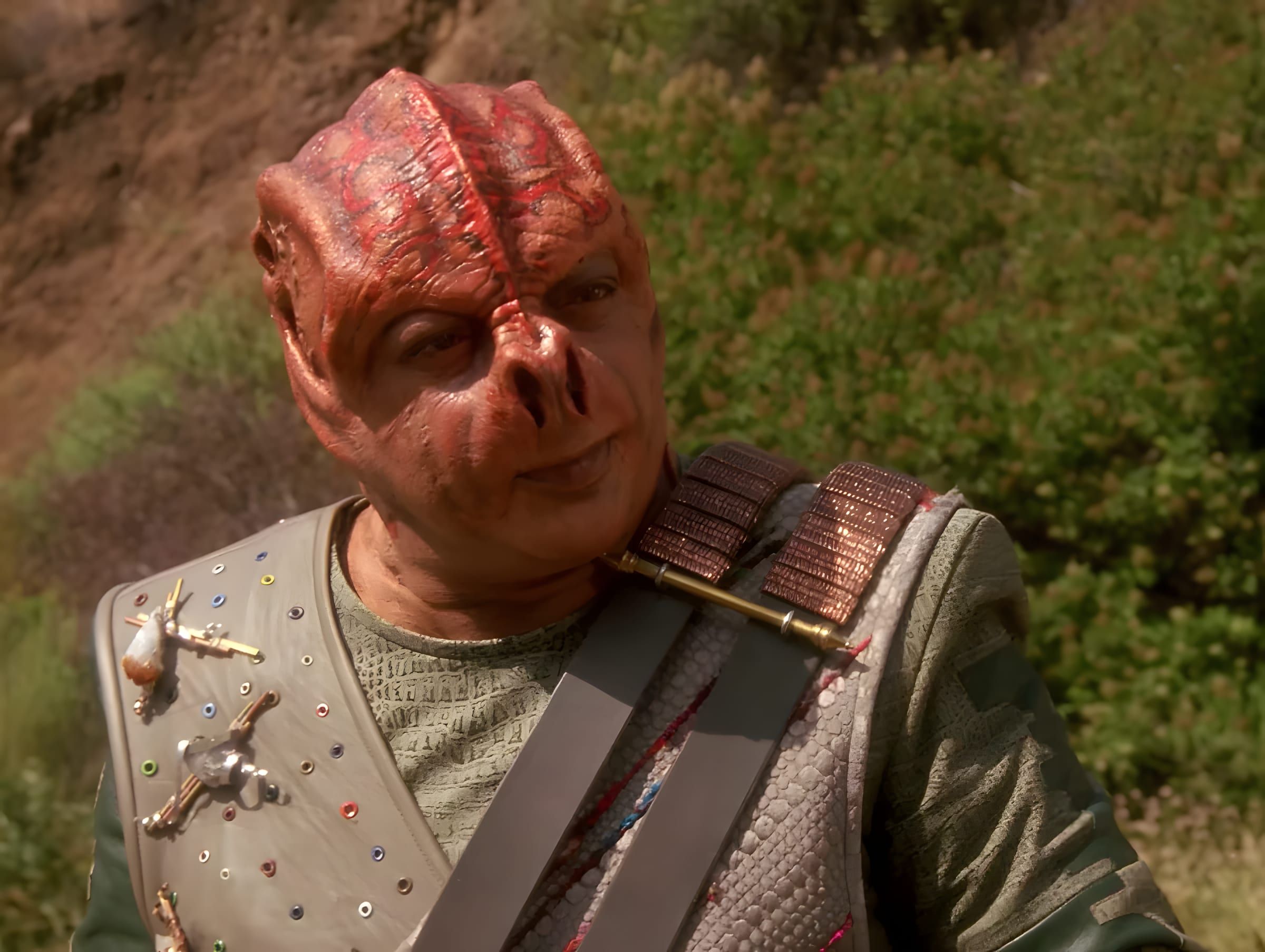
The Children of Tama, commonly called Tamarians, were a humanoid civilization from Sigma Tama IV whose contact history with the Federation was defined less by hostility than by failed interpretation. Starfleet had encountered them repeatedly before 2368, but ordinary diplomatic procedure could not overcome a language built from shared narrative references rather than direct lexical statements.
Their importance in Picard's record rests on the El-Adrel IV mission. The encounter transformed the Tamarians from an unresolved communications problem into a durable example of first contact under pressure. It also showed that the universal translator, though central to Federation exploration, could not substitute for cultural comprehension.
Role in Picard's Career
The role in Picard's career was unusually concentrated: a single crisis forced him to abandon reliance on technology, rank, and standard diplomatic vocabulary. Picard's command of the USS Enterprise-D placed him at the center of a mission that Starfleet operations involving the Tamarians had failed to complete for more than a century.
Captain Dathon's decision to isolate himself with Picard on El-Adrel IV was coercive, but it was not a conventional abduction. It was an attempt to create a shared historical reference through danger, sacrifice, and mutual dependence. Picard's achievement was his recognition that the Tamarian problem was not silence or irrationality, but a coherent system whose grammar depended on cultural memory.
Key Events and Actions
In 2368, a Tamarian vessel transmitted a mathematical hail that Starfleet interpreted as an invitation to communicate. The Enterprise-D proceeded to El-Adrel IV, where Dathon initiated the encounter by transporting himself and Picard to the planet's surface. A scattering field then prevented retrieval by transporter and forced both crews into a dangerous standoff.
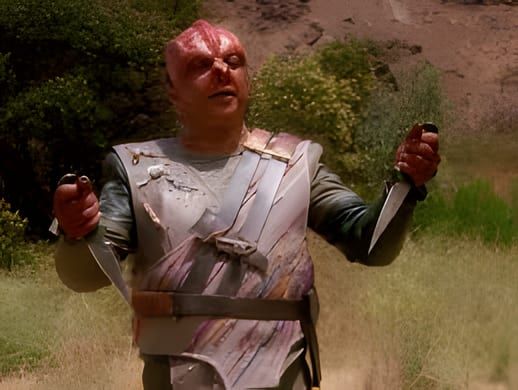
Dathon framed the meeting through the Tamarian expression of Darmok and Jalad at Tanagra, a reference to cooperation against a common threat. On the surface, he and Picard faced the hostile life-form that made the analogy operational rather than theoretical. Dathon died from the encounter, but Picard had by then begun to understand the structure of Tamarian speech well enough to address the Tamarian crew and prevent further escalation with the Enterprise.
The aftermath gave the Tamarians a new reference: Picard and Dathon at El-Adrel. The phrase recorded both loss and contact. It converted one captain's death into a diplomatic bridge, and it placed USS Enterprise-D operations within one of Starfleet's clearest studies of language as strategy.
Relationship to Picard
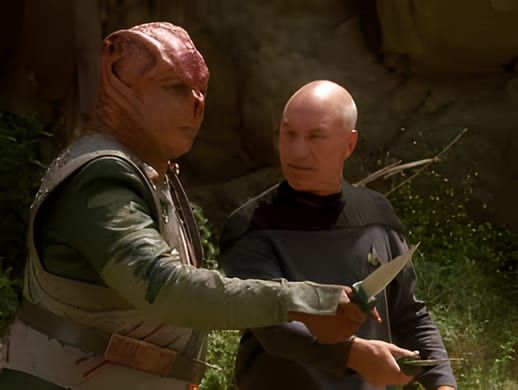
The Tamarian relationship to Picard began in mistrust and ended in ritual recognition. Dathon treated Picard not as an enemy to defeat but as the necessary participant in a constructed historical moment. His method exposed Picard to danger, yet it also entrusted him with the survival of Tamarian-Federation understanding.
Picard's later remembrance of Dathon is significant because it was not merely diplomatic courtesy. He adopted the Tamarian gesture of mourning with the dagger Dathon had given him, acknowledging that a foreign ceremonial language had become intelligible through experience. An award from the Children of Tama was later preserved among Picard's archival holdings, evidence that the encounter remained part of his personal and institutional record.
Strategic and Historical Significance
The strategic significance of the Children of Tama lies in the limits they revealed in Federation procedure. The Tamarians possessed starships, weapons, ritual hierarchy, written records, and disciplined command structures. The obstacle was not technological parity or military threat, but a linguistic system whose meaning depended on stories unavailable to outsiders.
For Picard, the encounter belongs beside later and earlier tests involving Borg, Q, and Data, where assumptions about communication, identity, and personhood failed under pressure. El-Adrel demonstrated that peaceful intent can still produce violence when the parties lack a shared interpretive frame. It also showed that first contact may require an officer to become a witness before becoming a negotiator.
Tamarian Language Structure
Tamarian speech is built from shared narrative references rather than direct lexical statements. A phrase such as Darmok and Jalad at Tanagra invokes a story of cooperation against danger; the listener must know the story to know the meaning.
Starfleet linguists had catalogued Tamarian transmissions for decades before 2368 but could not construct a grammar because the universal translator rendered individual words while leaving referential meaning opaque. The Children of Tama were therefore misread as incoherent when they were, in fact, highly structured.
Written Tamarian records exist aboard their vessels, confirming that the civilization possesses history, law, and command hierarchy expressed through the same metaphorical idiom. First contact failed not from absence of culture but from absence of shared stories.
Tamarian bridge commands often pair proper names with place names, turning geography into grammar. Officers who learn only vocabulary without mythography hear nonsense; officers who learn the stories hear command intent.
The universal translator's failure at El-Adrel was therefore a category error: the device translated words while leaving referents empty. Picard's breakthrough came when he stopped asking what the words meant in isolation and started asking what story Dathon was invoking. The fullest surviving glossary of attested phrases is preserved in the Tamarian language record; the examples below show the system's range.
| Phrase | Meaning |
|---|---|
| Darmok and Jalad at Tanagra | Cooperation; two strangers united against a common danger |
| Shaka, when the walls fell | Failure; an effort that has collapsed |
| Darmok on the ocean | Isolation; being alone |
| Temba, his arms wide | Generosity; the offering of a gift |
| Temba, at rest | The gift may be kept; no return is required |
| Sokath, his eyes uncovered | Understanding; sudden revelation |
| Uzani, his army with fists open | Tactical instruction: lure the enemy in |
| Mirab, with sails unfurled | Departure; setting out |
| The river Temarc in winter | Silence; an instruction to be still |
| Picard and Dathon at El-Adrel | Successful contact through shared trial (added 2368) |
Glosses follow Federation linguistic reconstructions; Tamarian usage embeds each phrase in narrative context that no short table can fully render.
El-Adrel IV and Captain Dathon
Captain Dathon's decision to transport himself and Picard to El-Adrel IV was an attempt to manufacture shared experience when shared stories did not yet exist. By forcing both men to face the planet's hostile life-form together, he sought to create a reference both cultures could use afterward.
Dathon's gift of a dagger was initially misread by Picard as combat challenge. In Tamarian logic it was an offer of survival tools within a ritual frame. The misunderstanding nearly ended the mission in violence before danger made cooperation literal.
When Dathon was mortally wounded, Picard began to speak in Tamarian idiom, telling the Tamarian crew that Darmok and Jalad had been at Tanagra and that Picard and Dathon were now at El-Adrel. The phrase gave the Tamarians a new story that included Picard as participant rather than obstacle.
The hostile entity on El-Adrel's surface forced Picard to depend on Dathon for tactical guidance he could not obtain from the Enterprise. Shared danger made metaphor operational: the story Darmok and Jalad at Tanagra became true in real time.
Dathon's death was not a failure of first contact but its price. He spent his life so that both crews could inherit a reference large enough to prevent war.
Institutional Consequences for Starfleet
After El-Adrel, Starfleet revised first-contact doctrine to include narrative acquisition alongside linguistic parsing. The Tamarian case is still taught as proof that communication requires cultural comprehension, not merely translation.
Picard's award from the Children of Tama and his retention of Dathon's dagger in personal archives show that the encounter remained part of his identity long after the mission ended. He later cited Tamarian patience when facing other communications crises, including early Borg contact and negotiations with the Q Continuum.
For the USS Enterprise-D record, El-Adrel is the mission that proved Picard could abandon technological shortcuts when rank and procedure failed. It belongs beside his defense of Data's personhood as an example of ethics expressed through interpretation rather than force.
Diplomatic corps manuals after 2368 include a Tamarian addendum requiring mythographic research before first reply. The addendum is short, but its existence marks a permanent change in Federation procedure.
Picard's later remark that communication requires patience and imagination is often traced to El-Adrel, even when he applied the same principle in wholly unrelated negotiations.
Legacy
The legacy of the Children of Tama in Picard's career is a disciplined warning against treating translation as understanding. Their culture preserved meaning through compressed historical allusion, gesture, and ceremonial conduct. Once Picard grasped that structure, he did not master Tamarian language in full; he acquired enough shared reference to prevent a fatal misunderstanding from becoming policy.
By the early 2380s, Tamarian integration had advanced far enough for Kayshon to serve in Starfleet, with translator systems capable of rendering the language imperfectly. That later service suggests that Dathon's sacrifice achieved more than the end of a single crisis. It opened a path from mutual incomprehension to institutional participation, making the Children of Tama an enduring case study in Federation diplomacy.
The Children of Tama entered Federation history as the civilization that could not be understood until a captain was willing to become a character in their story. Dathon's death purchased that understanding at personal cost.
Picard and Dathon at El-Adrel remains a standard reference in diplomatic training: a reminder that peaceful intent can produce violence when interpretive frames do not align, and that the first duty of contact may be to witness before negotiating.
In Picard's archive, the Tamarians stand as proof that exploration is as much listening as travel—and that some of the hardest first contacts require an officer to risk his life inside another culture's metaphor before either side can speak plainly.
Search interest in Tamarian language and the Children of Tama remains high because El-Adrel solved a problem every explorer fears: meeting a civilized people and still being unable to speak.
For Picard personally, Dathon remains among the foreign captains he honored with ritual gesture—a rare admission that another commander had taught him something fundamental about his own profession.